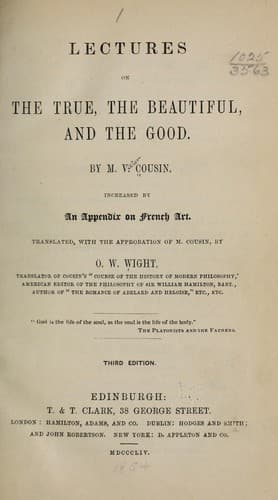
Lectures on the true, the beautiful and the goodCousin, Victor
Philosophy
Lectures on the true, the beautiful and the good
Cousin, Victor
Aesthetics; Ethics; Truth
A wise philosophy distinguishes[74] them without separating them.
Analysis demonstrates that reason precedes, and that sentiment follows.
How can we love what we are ignorant of? In order to enjoy the truth, is
it not necessary to know it more or less? In order to be moved by
certain ideas, is it not necessary to have possessed them in some
degree? To absorb reason in sentiment is to stifle the cause in the
effect. When one speaks of the light of the heart, he designates,
without knowing it, that light of the spontaneous reason which discovers
to us truth by a pure and immediate intuition entirely opposite to the
slow and laborious processes of the reflective reason and reasoning.
Sentiment by itself is a source of emotion, not of knowledge. The sole
faculty of knowledge is reason. At bottom, if sentiment is different
from sensation, it nevertheless pertains on all sides to general
sensibility, and it is, like it, variable; it has, like it, its
interruptions, its vivacity, and its lassitude, its exaltation and its
short-comings. The inspirations of sentiment, then, which are
essentially mobile and individual, cannot be raised to a universal and
absolute rule. It is not so with reason; it is constantly the same in
each one of us, the same in all men. The laws that govern its exercise
constitute the common legislation of all intelligent beings. There is no
intelligence that does not conceive some universal and necessary truth,
and, consequently, the infinite being who is its principle. These grand
objects being once known excite in the souls of all men the emotions
that we have endeavored to describe. These emotions partake of the
dignity of reason and the mobility of imagination and sensibility.
Sentiment is the harmonious and living relation between reason and
sensibility. Suppress one of the two terms, and what becomes of the
relation? Mysticism pretends to elevate man directly to God, and does
not see that in depriving reason of its power, it really deprives him of
that which makes him know God, and puts him in a just communication with
God by the intermediary of eternal and infinite truth.
Public-domain text, read in full here on John Shaqi.
Reviews
Reviews
No reviews yet
Be the first to share your thoughts on this work.
Elsewhere in the archive
Join the Discussion
Join the discussion
Sign in to leave a comment or review.
Sign InorCreate an account