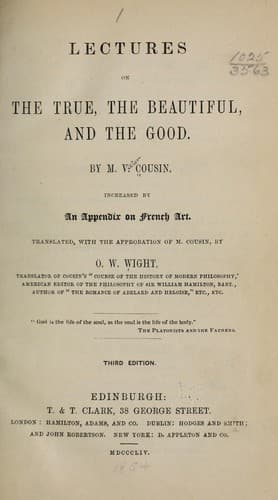
Lectures on the true, the beautiful and the goodCousin, Victor
Philosophy
Lectures on the true, the beautiful and the good
Cousin, Victor
Aesthetics; Ethics; Truth
The fundamental error of mysticism is, that it discards this
intermediary, as if it were a barrier and not a tie: it makes the
infinite being the direct object of love. But such a love can be
sustained only by superhuman efforts that end in folly. Love tends to
unite itself with its object: mysticism absorbs love in its object.
Hence the extravagances of that mysticism so severely and so justly
condemned by Bossuet and the Church in quietism.[75] Quietism lulls to
sleep the activity of man, extinguishes his intelligence, substitutes
indolent and irregular contemplation for the seeking of truth and the
fulfilment of duty. The true union of the soul with God is made by truth
and virtue. Every other union is a chimera, a peril, sometimes a crime.
It is not permitted man to reject, under any pretext, that which makes
him man, that which renders him capable of comprehending God, and
expressing in himself an imperfect image of God, that is to say, reason,
liberty, conscience. Without doubt, virtue has its prudence, and if we
must never yield to passion, there are diverse ways of combating it in
order to conquer it. One can let it subside, and resignation and silence
may have their legitimate employment. There is a portion of truth, of
utility even, in the _Spiritual Letters_, even in the _Maxims of the
Saints_. But, in general, it is unsafe to anticipate in this world the
prerogatives of death, and to dream of sanctity when virtue alone is
required of us, when virtue is so difficult to attain, even imperfectly.
The best quietism can, at most, be only a halt in the course, a truce in
the strife, or rather another manner of combating. It is not by flight
that battles are gained; in order to gain them it is necessary to come
to an engagement, so much the more as duty consists in combating still
more than in conquering. Of the two opposite extremes--stoicism and
quietism--the first, taken all in all, is preferable to the second; for
if it does not always elevate man to God, it maintains, at least, human
personality, liberty, conscience, whilst quietism, in abolishing these,
abolishes the entire man. Oblivion of life and its duties, inertness,
sloth, death of soul,--such are the fruits of that love of God, which is
lost in the sterile contemplation of its object, provided it does not
cause still sadder aberrations! There comes a moment when the soul that
believes itself united with God, puffed up with this imaginary
possession, despises both the body and human personality to such an
extent that all its actions become indifferent to it, and good and evil
are in its eyes the same. Thus it is that fanatical sects have been seen
mingling crime and devotion, finding in one the excuse, often even the
motive, of the other, and prefacing infamous irregularities or
abominable cruelties with mystic transports,--deplorable consequences of
the chimera of pure love, of the pretension of sentiment to rule over
Public-domain text, read in full here on John Shaqi.
Reviews
Reviews
No reviews yet
Be the first to share your thoughts on this work.
Elsewhere in the archive
Join the Discussion
Join the discussion
Sign in to leave a comment or review.
Sign InorCreate an account