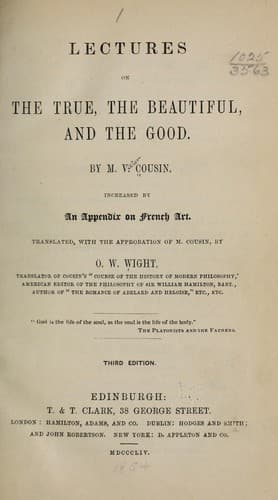
Lectures on the true, the beautiful and the goodCousin, Victor
Philosophy
Lectures on the true, the beautiful and the good
Cousin, Victor
Aesthetics; Ethics; Truth
reason, to serve alone as a guide to the human soul, and to put itself
in direct communication with God, without the intermediary of the
visible world, and without the still surer intermediary of intelligence
and truth.
But it is time to pass to another kind of mysticism, more singular, more
learned, more refined, and quite as unreasonable, although it presents
itself in the very name of reason.
We have seen[76] that reason, if one of the principles which govern it
be destroyed, cannot lay hold of truth, not even absolute truths of the
intellectual and moral order; it refers all universal, necessary,
absolute truths, to the being that alone can explain them, because in
him alone are necessary and absolute existence, immutability, and
infinity. God is the substance of uncreated truths, as he is the cause
of created existences. Necessary truths find in God their natural
subject. If God has not arbitrarily made them,--which is not in
accordance with their essence and his,--he constitutes them, inasmuch as
they are himself. His intelligence possesses them as the manifestations
of itself. As long as our intelligence has not referred them to the
divine intelligence, they are to it an effect without cause, a
phenomenon without substance. It refers them, then, to their cause and
their substance. And in that it obeys an imperative need, a fixed
principle of reason.
Mysticism breaks in some sort the ladder that elevates us to infinite
substance: it regards this substance alone, independently[77] of the
truth that manifests it, and it imagines itself to possess also the
pure absolute, pure unity, being in itself. The advantage which
mysticism here seeks, is to give to thought an object wherein there is
no mixture, no division, no multiplicity, wherein every sensible and
human element has entirely disappeared. But in order to obtain this
advantage, it must pay the cost of it. It is a very simple means of
freeing theodicea from every shade of anthropomorphism; it is reducing
God to an abstraction, to the abstraction of being in itself. Being in
itself, it is true, is free from all division, but upon the condition
that it have no attribute, no quality, and even that it be deprived of
knowledge and intelligence; for intelligence, if elevated as it might
be, always supposes the distinction between the intelligent subject and
the intelligible object. A God from whom absolute unity excludes
intelligence, is the God of the mystic philosophy.
How could the school of Alexandria, how could Plotinus, its
founder,[78] in the midst of the lights of the Greek and Latin
civilization, have arrived at such a strange notion of the Divinity? By
the abuse of Platonism, by the corruption of the best and severest
method, that of Socrates and Plato.
Public-domain text, read in full here on John Shaqi.
Reviews
Reviews
No reviews yet
Be the first to share your thoughts on this work.
Elsewhere in the archive
Join the Discussion
Join the discussion
Sign in to leave a comment or review.
Sign InorCreate an account