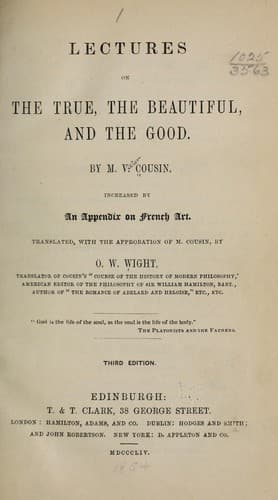
Lectures on the true, the beautiful and the goodCousin, Victor
Philosophy
Lectures on the true, the beautiful and the good
Cousin, Victor
Aesthetics; Ethics; Truth
The Platonic method, the dialectic process, as its author calls it,
searches in particular, variable, contingent things, for what they also
have general, durable, one, that is to say, their Idea, and is thus
elevated to Ideas, as to the only true objects of intelligence, in order
to be elevated still from these Ideas, which are arranged in an
admirable hierarchy, to the first of all, beyond which intelligence has
nothing more to conceive, nothing more to seek. By rejecting in finite
things their limit, their individuality, we attain genera, Ideas, and,
by them, their sovereign principle. But this principle is not the last
of genera, nor the last of abstractions; it is a real and substantial
principle.[79] The God of Plato is not called merely unity, he is called
the Good; he is not the lifeless substance of the Eleatics;[80] he is
endowed with _life and movement_;[81] strong expressions that show how
much the God of the Platonic metaphysics differs from that of mysticism.
This God is the _father of the world_.[82] He is also the father of
truth, that light of spirits.[83] He dwells in the midst of Ideas _which
make him a true God inasmuch as he is with them_.[84] He possesses
_august and holy intelligence_.[85] He has made the world without any
external necessity, and for the sole reason that he is good.[86] In
fine, he is beauty without mixture, unalterable, immortal, that makes
him who has caught a glimpse of it disdain all earthly beauties.[87] The
beautiful, the absolute good, is too dazzling to be looked on directly
by the eye of mortal; it must at first be contemplated in the images
that reveal it to us, in truth, in beauty, in justice, as they are met
here below, and among men, as the eye of one who has been a chained
captive from infancy, must be gradually habituated to the light of the
sun.[88] Our reason, enlightened by true science, can perceive this
light of spirits; reason rightly led can go to God, and there is no
need, in order to reach him, of a particular and mysterious faculty.
Public-domain text, read in full here on John Shaqi.
Reviews
Reviews
No reviews yet
Be the first to share your thoughts on this work.
Elsewhere in the archive
Join the Discussion
Join the discussion
Sign in to leave a comment or review.
Sign InorCreate an account