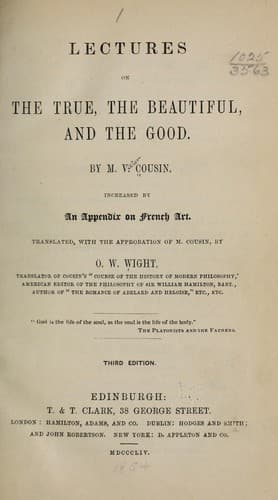
Lectures on the true, the beautiful and the goodCousin, Victor
Philosophy
Lectures on the true, the beautiful and the good
Cousin, Victor
Aesthetics; Ethics; Truth
Plotinus erred by pushing to excess the Platonic dialectics, and by
extending them beyond the boundary where they should stop. In Plato they
terminate at ideas, at the idea of the good, and produce an intelligent
and good God; Plotinus applies them without limit, and they lead him
into an abyss of mysticism. If all truth is in the general, and if all
individuality is imperfection, it follows, that as long as we are able
to generalize, as long as it is possible for us to overlook any
difference, to exclude any determination, we shall not be at the limit
of dialectics. Its last object, then, will be a principle without any
determination. It will not spare in God being itself. In fact, if we say
that God is a being, by the side of and above being, we place unity, of
which being partakes, and which it cannot disengage, in order to
consider it alone. Being is not here simple, since it is at once being
and unity; unity alone is simple, for one cannot go beyond that. And
still when we say unity, we determine it. True absolute unity must,
then, be something absolutely indeterminate, which is not, which,
properly speaking, cannot be named, the _unnamable_, as Plotinus says.
This principle, which exists not, for a still stronger reason, cannot
think, for all thought is still a determination, a manner of being. So
being and thought are excluded from absolute unity. If Alexandrianism
admits them, it is only as a forfeiture, a degradation of unity.
Considered in thought, and in being, the supreme principle is inferior
to itself; only in the pure simplicity of its indefinable essence is it
the last object of science, and the last term of perfection.
In order to enter into communication with such a God, the ordinary
faculties are not sufficient, and the theodicea of the school of
Alexandria imposes upon it a quite peculiar psychology.
In the truth of things, reason conceives absolute unity as an attribute
of absolute being, but not as something in itself, or, if it considers
it apart, it knows that it considers only an abstraction. Does one wish
to make absolute unity something else than an attribute of an absolute
being, or an abstraction, a conception of human intelligence? Reason
could accept nothing more on any condition. Will this barren unity be
the object of love? But love, much more than reason, aspires after a
real object. One does not love substance in general, but a substance
that possesses such or such a character. In human friendships, suppress
all the qualities of a person, or modify them, and you modify or
suppress the love. This does not prove that you do not love this person;
it only proves that the person is not for you without his qualities.
Public-domain text, read in full here on John Shaqi.
Reviews
Reviews
No reviews yet
Be the first to share your thoughts on this work.
Elsewhere in the archive
Join the Discussion
Join the discussion
Sign in to leave a comment or review.
Sign InorCreate an account