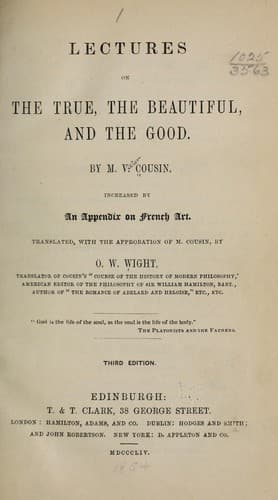
Lectures on the true, the beautiful and the goodCousin, Victor
Philosophy
Lectures on the true, the beautiful and the good
Cousin, Victor
Aesthetics; Ethics; Truth
So neither reason nor love can attain the absolute unity of mysticism.
In order to correspond to such an object, there must be in us something
analogous to it, there must be a mode of knowing that implies the
abolition of consciousness. In fact, consciousness is the sign of the
_me_, that is to say, of that which is most determinate: the being who
says, _me_, distinguishes himself essentially from every other; that is
for us the type itself of individuality. Consciousness should degrade
the ideal of dialectic knowledge, or every division, every determination
must be wanting, in order to respond to the absolute unity of its
object. This mode of pure and direct communication with God, which is
not reason, which is not love, which excludes consciousness, is ecstasy
([Greek: ekstasis]). This word, which Plotinus first applied to this
singular state of the soul, expresses this separation from ourselves
which mysticism exacts, and of which it believes man capable. Man, in
order to communicate with absolute being, must go out of himself. It is
necessary that thought should reject all determinate thought, and, in
falling back within its own depths, should arrive at such an oblivion of
itself, that consciousness should vanish or seem to vanish. But that is
only an image of ecstasy; what it is in itself, no one knows; as it
escapes all consciousness, it escapes memory, escapes reflection, and
consequently all expression, all human speech.
This philosophical mysticism rests upon a radically false notion of
absolute being. By dint of wishing to free God from all the conditions
of finite existence, one comes to deprive him of all the conditions of
existence itself; one has such a fear that the infinite may have
something in common with the finite, that he does not dare to recognize
that being is common to both, save difference of degree, as if all that
is not were not nothingness itself! Absolute being possesses absolute
unity without any doubt, as it possesses absolute intelligence; but,
once more, absolute unity without a real subject of inherence is
destitute of all reality. Real and determinate are synonyms. What
constitutes a being is its special nature, its essence. A being is
itself only on the condition of not being another; it cannot but have
characteristic traits. All that is, is such or such. Difference is an
element as essential to being as unity itself. If, then, reality is in
determination, it follows that God is the most determinate of beings.
Aristotle is much more Platonic than Plotinus, when he says that God is
the thought of thought,[89] that he is not a simple power, but a power
effectively acting, meaning thereby that God to be perfect, ought to
have nothing in himself that is not completed. To finite nature it
belongs to be, in a certain sense, indeterminate, since being finite, it
has always in itself powers that are not realized; this indetermination
diminishes as these powers are realized. So true divine unity is not
Public-domain text, read in full here on John Shaqi.
Reviews
Reviews
No reviews yet
Be the first to share your thoughts on this work.
Elsewhere in the archive
Join the Discussion
Join the discussion
Sign in to leave a comment or review.
Sign InorCreate an account