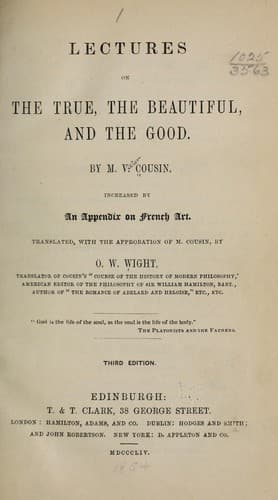
Lectures on the true, the beautiful and the goodCousin, Victor
Philosophy
Lectures on the true, the beautiful and the good
Cousin, Victor
Aesthetics; Ethics; Truth
[95] One was then ardently occupied with magnetism, and more than a
magnetizer, half a materialist, half a visionary, pretended to convert
us to a system of perfect clairvoyance of soul, obtained by means of
artificial sleep. Alas! the same follies are now renewed. Conjunctions
are the fashion. Spirits are interrogated, and they respond! Only let
there be consciousness that one does not interrogate, and superstition
alone counterpoises skepticism.
PART SECOND
THE BEAUTIFUL.
LECTURE VI.
THE BEAUTIFUL IN THE MIND OF MAN.
The method that must govern researches on the beautiful and art
is, as in the investigation of the true, to commence by
psychology.--Faculties of the soul that unite in the perception
of the beautiful.--The senses give only the agreeable; reason
alone gives the idea of the beautiful.--Refutation of
empiricism, that confounds the agreeable and the
beautiful.--Pre-eminence of reason.--Sentiment of the beautiful;
different from sensation and desire.--Distinction between the
sentiment of the beautiful and that of the
sublime.--Imagination.--Influence of sentiment on
imagination.--Influence of imagination on sentiment.--Theory of
taste.
Let us recall in a few words the results at which we have arrived.
Two exclusive schools are opposed to each other in the eighteenth
century; we have combated both, and each by the other. To empiricism we
have opposed the insufficiency of sensation, and its own inevitable
necessity to idealism. We have admitted, with Locke and Condillac, in
regard to the origin of knowledge, particular and contingent ideas,
which we owe to the senses and consciousness; and above the senses and
consciousness, the direct sources of all particular ideas, we have
recognized, with Reid and Kant, a special faculty, different from
sensation and consciousness, but developed with them,--reason, the lofty
source of universal and necessary truths. We have established, against
Kant, the absolute authority of reason, and the truths which it
discovers. Then, the truths that reason revealed to us have themselves
revealed to us their eternal principle,--God. Finally, this rational
spiritualism, which is both the faith of the human race and the doctrine
of the greatest minds of antiquity and modern times, we have carefully
distinguished from a chimerical and dangerous mysticism. Thus the
necessity of experience and the necessity of reason, the necessity of a
real and infinite being which is the first and last foundation of truth,
a severe distinction between spiritualism and mysticism, are the great
principles which we have been able to gather from the first part of this
course.
The second part, the study of the beautiful, will give us the same
results elucidated and aggrandized by a new application.
Public-domain text, read in full here on John Shaqi.
Reviews
Reviews
No reviews yet
Be the first to share your thoughts on this work.
Elsewhere in the archive
Join the Discussion
Join the discussion
Sign in to leave a comment or review.
Sign InorCreate an account