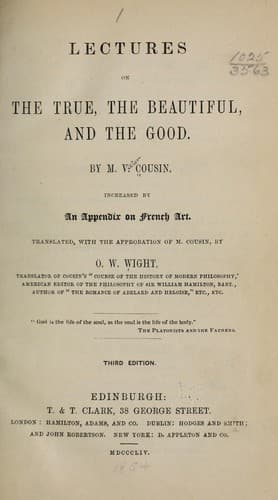
Lectures on the true, the beautiful and the goodCousin, Victor
Philosophy
Lectures on the true, the beautiful and the good
Cousin, Victor
Aesthetics; Ethics; Truth
It was the eighteenth century that introduced, or rather brought back
into philosophy, investigations on the beautiful and art, so familiar to
Plato and Aristotle, but which scholasticism had not entertained, to
which our great philosophy of the seventeenth century had remained
almost a stranger.[96] One comprehends that it did not belong to the
empirical school to revive this noble part of philosophic science. Locke
and Condillac did not leave a chapter, not even a single page, on the
beautiful. Their followers treated beauty with the same disdain; not
knowing very well how to explain it in their system, they found it more
convenient not to perceive it at all. Diderot, it is true, had an
enthusiasm for beauty and art, but enthusiasm was never so ill placed.
Diderot had genius; but, as Voltaire said of him, his was a head in
which every thing fermented without coming to maturity. He scattered
here and there a mass of ingenious and often contradictory perceptions;
he has no principles; he abandons himself to the impression of the
moment; he knows not what the ideal is; he delights in a kind of nature,
at once common and mannered, such as one might expect from the author
of the _Interpretation de la Nature_, the _Pere de Famille_, the _Neveu
de Rameau_, and _Jacques le Fataliste_. Diderot is a fatalist in art as
well as in philosophy; he belongs to his times and his school, with a
grain of poetry, sensibility, and imagination.[97] It was worthy of the
Scotch[98] school and Kant[99] to give a place to the beautiful in their
doctrine. They considered it in the soul and in nature; but they did not
even touch the difficult question of the reproduction of the beautiful
by the genius of man. We will try to embrace this great subject in its
whole extent, and we are about to offer at least a sketch of a regular
and complete theory of beauty and art.
Let us begin by establishing well the method that must preside over
these investigations.
One can study the beautiful in two ways:--either out of us, in itself
and in the objects, whatever they may be, that bear its impress; or in
the mind of man, in the faculties that attain it, in the ideas or
sentiments that it excites in us. Now, the true method, which must now
be familiar to you, makes setting out from man to arrive at things a law
for us. Therefore psychological analysis will here again be our point of
departure, and the study of the state of the soul in presence of the
beautiful will prepare us for that of the beautiful considered in itself
and its objects.
Let us interrogate the soul in the presence of beauty.
Public-domain text, read in full here on John Shaqi.
Reviews
Reviews
No reviews yet
Be the first to share your thoughts on this work.
Elsewhere in the archive
Join the Discussion
Join the discussion
Sign in to leave a comment or review.
Sign InorCreate an account