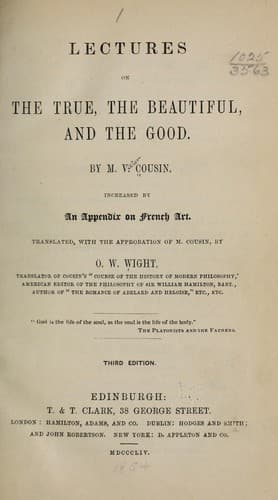
Lectures on the true, the beautiful and the goodCousin, Victor
Philosophy
Lectures on the true, the beautiful and the good
Cousin, Victor
Aesthetics; Ethics; Truth
Is it not an incontestable fact that before certain objects, under very
different circumstances, we pronounce the following judgment:--This
object is beautiful? This affirmation is not always explicit. Sometimes
it manifests itself only by a cry of admiration; sometimes it silently
rises in the mind that scarcely has a consciousness of it. The forms of
this phenomenon vary, but the phenomenon is attested by the most common
and most certain observation, and all languages bear witness of it.
Although sensible objects, with most men, oftenest provoke the judgment
of the beautiful, they do not alone possess this advantage; the domain
of beauty is more extensive than the domain of the physical world
exposed to our view; it has no bounds but those of entire nature, and of
the soul and genius of man. Before an heroic action, by the remembrance
of a great sacrifice; even by the thought of the most abstract truths
firmly united with each other in a system admirable at once for its
simplicity and its productiveness; finally, before objects of another
order, before the works of art, this same phenomenon is produced in us.
We recognize in all these objects, however different, a common quality
in regard to which our judgment is pronounced, and this quality we call
beauty.
The philosophy of sensation, in faithfulness to itself, should have
attempted to reduce the beautiful to the agreeable.
Without doubt, beauty is almost always agreeable to the senses, or at
least it must not wound them. Most of our ideas of the beautiful come to
us by sight and hearing, and all the arts, without exception, are
addressed to the soul through the body. An object which makes us suffer,
were it the most beautiful in the world, very rarely appears to us such.
Beauty has little influence over a soul occupied with grief.
But if an agreeable sensation often accompanies the idea of the
beautiful, we must not conclude that one is the other.
Experience testifies that all agreeable things do not appear beautiful,
and that, among agreeable things, those which are most so are not the
most beautiful,--a sure sign that the agreeable is not the beautiful;
for if one is identical with the other, they should never be separated,
but should always be commensurate with each other.
Public-domain text, read in full here on John Shaqi.
Reviews
Reviews
No reviews yet
Be the first to share your thoughts on this work.
Elsewhere in the archive
Join the Discussion
Join the discussion
Sign in to leave a comment or review.
Sign InorCreate an account