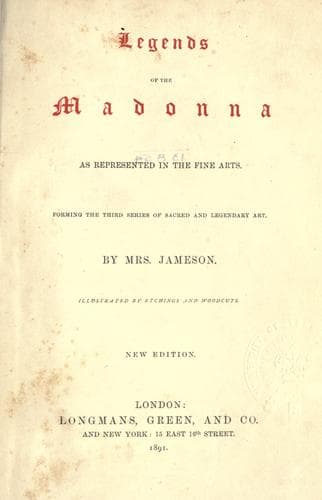
Legends of the Madonna as Represented in the Fine ArtsJameson, Mrs. (Anna)
Religion
Legends of the Madonna as Represented in the Fine Arts
Jameson, Mrs. (Anna)
Christian saints in art; Mary, Blessed Virgin, Saint -- Art; Mary, Blessed Virgin, Saint -- Legends
It is curious to observe, as the worship of the Virgin-mother expanded
and gathered to itself the relics of many an ancient faith, how
the new and the old elements, some of them apparently the most
heterogeneous, became amalgamated, and were combined into the early
forms of art;--how the Madonna, when she assumed the characteristics
of the great Diana of Ephesus, at once the type of Fertility, and the
Goddess of Chastity, became, as the impersonation of motherhood, all
beauty, bounty and graciousness; and at the same time, by virtue of
her perpetual virginity, the patroness of single and ascetic life--the
example and the excuse for many of the wildest of the early monkish
theories. With Christianity, new ideas of the moral and religious
responsibility of woman entered the world; and while these ideas were
yet struggling with the Hebrew and classical prejudices concerning the
whole sex, they seem to have produced some curious perplexity in the
minds of the greatest doctors of the faith. Christ, as they assure
us, was born of a woman only, and had no earthly father, that neither
sex might despair; "for had he been born a man (which was necessary),
yet not born of woman, the women might have despaired of themselves,
recollecting the first offence, the first man having been deceived by
a woman. Therefore we are to suppose that, for the exaltation of the
male sex, Christ appeared on earth as a man; and, for the consolation
of womankind, he was born of a woman only; as if it had been said,
'From henceforth no creature shall be base before God, unless
perverted by depravity.'" (Augustine, Opera Supt. 238, Serm. 63.)
Such is the reasoning of St. Augustine, who, I must observe, had an
especial veneration for his mother Monica; and it is perhaps for her
sake that he seems here desirous to prove that through the Virgin Mary
all womankind were henceforth elevated in the scale of being. And
this was the idea entertained of her subsequently: "Ennobler of thy
nature!" says Dante apostrophizing her, as if her perfections had
ennobled not merely her own sex, but the whole human race.[1]
[Footnote 1: "Tu se' colei che l'umana natura Nobilitasti."]
But also with Christianity came the want of a new type of womanly
perfection, combining all the attributes of the ancient female
divinities with others altogether new. Christ, as the model-man,
united the virtues of the two sexes, till the idea that there are
essentially masculine and feminine virtues intruded itself on the
higher Christian conception, and seems to have necessitated the
female type.
Public-domain text, read in full here on John Shaqi.
Reviews
Reviews
No reviews yet
Be the first to share your thoughts on this work.
Join the Discussion
Join the discussion
Sign in to leave a comment or review.
Sign InorCreate an account