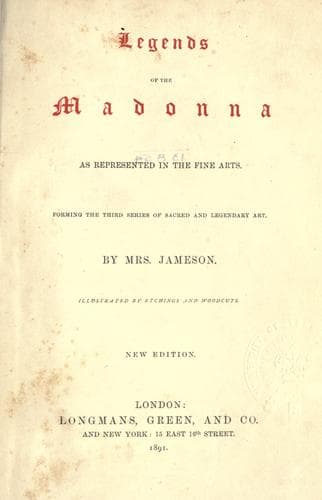
Legends of the Madonna as Represented in the Fine ArtsJameson, Mrs. (Anna)
Religion
Legends of the Madonna as Represented in the Fine Arts
Jameson, Mrs. (Anna)
Christian saints in art; Mary, Blessed Virgin, Saint -- Art; Mary, Blessed Virgin, Saint -- Legends
The first historical mention of a direct worship paid to the Virgin
Mary, occurs in a passage in the works of St. Epiphanius, who died
in 403. In enumerating the heresies (eighty-four in number) which had
sprung up in the early Church, he mentions a sect of women, who had
emigrated from Thrace into Arabia, with whom it was customary to
offer cakes of meal and honey to the Virgin Mary, as if she had been a
divinity, transferring to her, in fact, the worship paid to Ceres. The
very first instance which occurs in written history of an invocation
to Mary, is in the life of St. Justina, as related by Gregory
Nazianzen. Justina calls on the Virgin-mother to protect her against
the seducer and sorcerer, Cyprian; and does not call in vain. (Sacred
and Legendary Art.) These passages, however, do not prove that
previously to the fourth century there had been no worship or
invocation of the Virgin, but rather the contrary. However this may
be, it is to the same period--the fourth century--we refer the most
ancient representations of the Virgin in art. The earliest figures
extant are those on the Christian sarcophagi; but neither in the early
sculpture nor in the mosaics of St. Maria Maggiore do we find any
figure of the Virgin standing alone; she forms part of a group of
the Nativity or the Adoration of the Magi. There is no attempt at
individuality or portraiture. St. Augustine says expressly, that there
existed in his time no _authentic_ portrait of the Virgin; but it
is inferred from his account that, authentic or not, such pictures
did then exist, since there were already disputes concerning their
authenticity. There were at this period received symbols of the person
and character of Christ, as the lamb, the vine, the fish, &c., but
not, as far as I can learn, any such accepted symbols of the Virgin
Mary. Further, it is the opinion of the learned in ecclesiastical
antiquities that, previous to the first Council of Ephesus, it was the
custom to represent the figure of the Virgin alone without the Child;
but that none of these original effigies remain to us, only supposed
copies of a later date.[1] And this is all I have been able to
discover relative to her in connection with the sacred imagery of the
first four centuries of our era.
[Footnote 1: Vide "_Memorie dell' Immagine di M.V. dell' Imprunela_."
Florence, 1714.]
* * * * *
Public-domain text, read in full here on John Shaqi.
Reviews
Reviews
No reviews yet
Be the first to share your thoughts on this work.
Join the Discussion
Join the discussion
Sign in to leave a comment or review.
Sign InorCreate an account