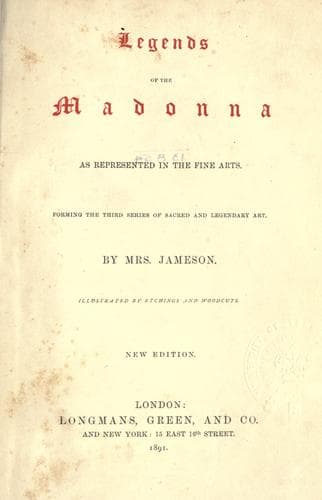
Legends of the Madonna as Represented in the Fine Arts — John Shaqi
Legends of the Madonna as Represented in the Fine ArtsJameson, Mrs. (Anna)
Religion
Legends of the Madonna as Represented in the Fine Arts
Jameson, Mrs. (Anna)
Christian saints in art; Mary, Blessed Virgin, Saint -- Art; Mary, Blessed Virgin, Saint -- Legends
The condemnation of Nestorius by the Council of Ephesus, in the year
431, forms a most important epoch in the history of religious art.
I have given further on a sketch of this celebrated schism, and its
immediate and progressive results. It may be thus summed up here. The
Nestorians maintained, that in Christ the two natures of God and man
remained separate, and that Mary, his human mother, was parent of
the man, but not of the God; consequently the title which, during
the previous century, had been popularly applied to her, "Theotokos"
(Mother of God), was improper and profane. The party opposed to
Nestorius, the Monophysite, maintained that in Christ the divine and
human were blended in one incarnate nature, and that consequently Mary
was indeed the Mother of God. By the decree of the first Council
of Ephesus, Nestorius and his party were condemned as heretics; and
henceforth the representation of that beautiful group, since popularly
known as the "Madonna and Child," became the expression of the
orthodox faith. Every one who wished to prove his hatred of the
arch-heretic exhibited the image of the maternal Virgin holding in
her arms the Infant Godhead, either in his house as a picture, or
embroidered on his garments, or on his furniture, on his personal
ornaments--in short, wherever it could be introduced. It is worth
remarking, that Cyril, who was so influential in fixing the orthodox
group, had passed the greater part of his life in Egypt, and must nave
been familiar with the Egyptian type of Isis nursing Horus. Nor, as I
conceive, is there any irreverence in supposing that a time-honoured
intelligible symbol should be chosen to embody and formalize a creed.
For it must be remembered that the group of the Mother and Child was
not at first a representation, but merely a theological symbol set up
in the orthodox churches, and adopted by the orthodox Christians.
Public-domain text, read in full here on John Shaqi.
Reviews
Reviews
No reviews yet
Be the first to share your thoughts on this work.
Join the Discussion
Join the discussion
Sign in to leave a comment or review.
Sign InorCreate an account