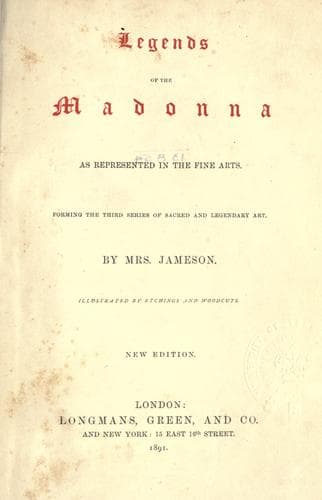
Legends of the Madonna as Represented in the Fine ArtsJameson, Mrs. (Anna)
Religion
Legends of the Madonna as Represented in the Fine Arts
Jameson, Mrs. (Anna)
Christian saints in art; Mary, Blessed Virgin, Saint -- Art; Mary, Blessed Virgin, Saint -- Legends
Then followed the schism of the Iconoclasts, which distracted
the Church for more than one hundred years, under Leo III., the
Isaurian, and his immediate successors. Such were the extravagances
of superstition to which the image-worship had led the excitable
Orientals, that, if Leo had been a wise and temperate reformer, he
might have done much good in checking its excesses; but he was himself
an ignorant, merciless barbarian. The persecution by which he sought
to exterminate the sacred pictures of the Madonna, and the cruelties
exercised on her unhappy votaries, produced a general destruction
of the most curious and precious remains of antique art. In other
respects, the immediate result was naturally enough a reaction, which
not only reinstated pictures in the veneration of the people, but
greatly increased their influence over the imagination; for it is at
this time that we first hear of a miraculous picture. Among those
who most strongly defended the use of sacred images in the churches,
was St. John Damascene, one of the great lights of the Oriental
Church. According to the Greek legend, he was condemned to lose his
right hand, which was accordingly cut off; but he, full of faith,
prostrating himself before a picture of the Virgin, stretched out the
bleeding stump, and with it touched her lips, and immediately a new
hand sprung forth "like a branch from a tree." Hence, among the Greek
effigies of the Virgin, there is one peculiarly commemorative of this
miracle, styled "the Virgin with three hands." (Didron, Manuel, p.
462.) In the west of Europe, where the abuses of the image-worship had
never yet reached the wild superstition of the Oriental Christians,
the fury of the Iconoclasts excited horror and consternation. The
temperate and eloquent apology for sacred pictures, addressed by
Gregory II. to the Emperor Leo, had the effect of mitigating the
persecution in Italy, where the work of destruction could not be
carried out to the same extent as in the Byzantine provinces. Hence it
is in Italy only that any important remains of sacred art anterior to
the Iconoclast dynasty have been preserved.[1]
[Footnote 1: It appears, from one of these letters from Gregory II,
that it was the custom at that time (725) to employ religious pictures
as a means of instruction in the schools. He says, that if Lee were
to enter a school in Italy, and to say that he prohibited pictures,
the children would infallibly throw their hornbooks (_Ta volexxe del
alfabeto_) at his head.--v. _Bosio_, p. 567.]
Public-domain text, read in full here on John Shaqi.
Reviews
Reviews
No reviews yet
Be the first to share your thoughts on this work.
Join the Discussion
Join the discussion
Sign in to leave a comment or review.
Sign InorCreate an account