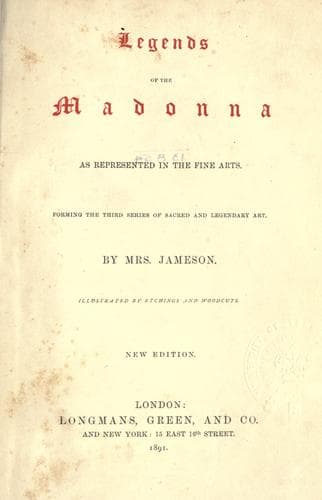
Legends of the Madonna as Represented in the Fine ArtsJameson, Mrs. (Anna)
Religion
Legends of the Madonna as Represented in the Fine Arts
Jameson, Mrs. (Anna)
Christian saints in art; Mary, Blessed Virgin, Saint -- Art; Mary, Blessed Virgin, Saint -- Legends
The second Council of Nice, under the Empress Irene in 787, condemned
the Iconoclasts, and restored the use of the sacred pictures in the
churches. Nevertheless, the controversy still raged till after the
death of Theophilus, the last and the most cruel of the Iconoclasts,
in 842. His widow Theodora achieved the final triumph of the orthodox
party, and restored the Virgin to her throne. We must observe,
however, that only pictures were allowed; all sculptured imagery
was still prohibited, and has never since been allowed in the Greek
Church, except in very low relief. The flatter the surface, the more
orthodox.
It is, I think, about 886, that we first find the effigy of the Virgin
on the coins of the Greek empire. On a gold coin of Leo VI., the
Philosopher, she stands veiled, and draped, with a noble head, no
glory, and the arms outspread, just as she appears in the old mosaics.
On a coin of Romanus the Younger, she crowns the emperor, having
herself the nimbus; she is draped and veiled. On a coin of Nicephorus
Phocus (who had great pretensions to piety), the Virgin stands,
presenting a cross to the emperor, with the inscription, "Theotokos,
be propitious." On a gold coin of John Zimisces, 975, we first find
the Virgin and Child,--the symbol merely: she holds against her bosom
a circular glory, within which is the head of the Infant Christ. In
the successive reigns of the next two centuries, she almost constantly
appears as crowning the emperor.
Returning to the West, we find that in the succeeding period, from
Charlemagne to the first crusade, the popular devotion to the Virgin,
and the multiplication of sacred pictures, continued steadily to
increase; yet in the tenth and eleventh centuries art was at its
lowest ebb. At this time, the subjects relative to the Virgin were
principally the Madonna and Child, represented according to the Greek
form; and those scenes from the Gospel in which she is introduced, as
the Annunciation, the Nativity, and the Worship of the Magi.
Towards the end of the tenth century the custom of adding the angelic
salutation, the "_Ave Maria_," to the Lord's prayer, was first
introduced; and by the end of the following century, it had been
adopted in the offices of the Church. This was, at first, intended as
a perpetual reminder of the mystery of the Incarnation, as announced
by the angel. It must have had the effect of keeping the idea of
Mary as united with that of her Son, and as the instrument of the
Incarnation, continually in the minds of the people.
Public-domain text, read in full here on John Shaqi.
Reviews
Reviews
No reviews yet
Be the first to share your thoughts on this work.
Join the Discussion
Join the discussion
Sign in to leave a comment or review.
Sign InorCreate an account