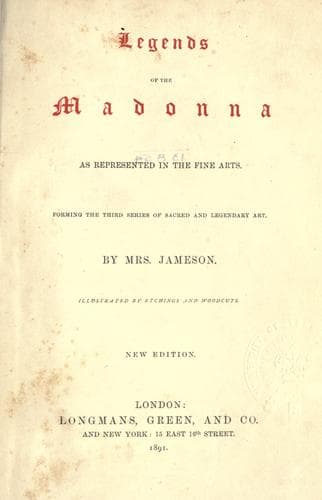
Legends of the Madonna as Represented in the Fine ArtsJameson, Mrs. (Anna)
Religion
Legends of the Madonna as Represented in the Fine Arts
Jameson, Mrs. (Anna)
Christian saints in art; Mary, Blessed Virgin, Saint -- Art; Mary, Blessed Virgin, Saint -- Legends
In the succeeding century these elements of poetic art, expanded and
animated by an awakened observation of nature, and a sympathy with
her external manifestations, were most especially directed by the
increasing influence of the worship of the Virgin, a worship at once
religious and chivalrous. The title of "Our Lady"[1] came first into
general use in the days of chivalry, for she was the lady "of all
hearts," whose colours all were proud to wear. Never had her votaries
so abounded. Hundreds upon hundreds had enrolled themselves in
brotherhoods, vowed to her especial service;[2] or devoted to acts of
charity, to be performed in her name.[3] Already the great religious
communities, which at this time comprehended all the enthusiasm,
learning, and influence of the Church, had placed themselves solemnly
and especially under her protection. The Cistercians wore white in
honour of her purity; the Servi wore black in respect to her sorrows;
the Franciscans had enrolled themselves as champions of the Immaculate
Conception; and the Dominicans introduced the rosary. All these richly
endowed communities vied with each other in multiplying churches,
chapels, and pictures, in honour of their patroness, and expressive of
her several attributes. The devout painter, kneeling before his easel,
addressed himself to the task of portraying those heavenly lineaments
which had visited him perhaps in dreams. Many of the professed monks
and friars became themselves accomplished artists.[4]
[Footnote 1: _Fr._ Notre Dame. _Ital._ La Madonna. _Ger._ Unser liebe
Frau.]
[Footnote 2: As the Serviti, who were called in France, _les esclaves
de Marie_.]
[Footnote 3: As the order of "Our Lady of Mercy," for the deliverance
of captives.--_Vide_ Legends of the Monastic Orders.]
[Footnote 4: A very curious and startling example of the theological
character of the Virgin in the thirteenth century is figured in Miss
Twining's work, "_The Symbols of early Christian Art_;" certainly the
most complete and useful book of the kind which I know of. Here the
Madonna and Child are seated side by side with the Trinity; the Holy
Spirit resting on her crowned head.]
At this time, Jacopo di Voragine compiled the "Golden Legend," a
collection of sacred stories, some already current, some new, or
in a new form. This famous book added many themes to those already
admitted, and became the authority and storehouse for the early
painters in their groups and dramatic compositions. The increasing
enthusiasm for the Virgin naturally caused an increasing demand for
the subjects taken from her personal history, and led, consequently,
to a more exact study of those natural objects and effects which were
required as accessories, to greater skill in grouping the figures, and
to a higher development of historic art.
Public-domain text, read in full here on John Shaqi.
Reviews
Reviews
No reviews yet
Be the first to share your thoughts on this work.
Join the Discussion
Join the discussion
Sign in to leave a comment or review.
Sign InorCreate an account