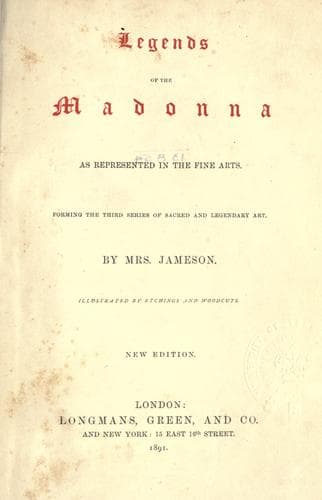
Legends of the Madonna as Represented in the Fine ArtsJameson, Mrs. (Anna)
Religion
Legends of the Madonna as Represented in the Fine Arts
Jameson, Mrs. (Anna)
Christian saints in art; Mary, Blessed Virgin, Saint -- Art; Mary, Blessed Virgin, Saint -- Legends
The pilgrimages to the Holy Land, and the crusades in the eleventh and
the twelfth centuries, had a most striking effect on religious art,
though this effect was not fully evolved till a century later. More
particularly did this returning wave of Oriental influences modify the
representations of the Virgin. Fragments of the apocryphal gospels
and legends of Palestine and Egypt were now introduced, worked up
into ballads, stories, and dramas, and gradually incorporated with the
teaching of the Church. A great variety of subjects derived from the
Greek artists, and from particular localities and traditions of the
East, became naturalized in Western Europe, Among these were the
legends of Joachim and Anna; and the death, the assumption, and the
coronation of the Virgin.
Then came the thirteenth century, an era notable in the history
of mind, more especially notable in the history of art. The seed
scattered hither and thither, during the stormy and warlike period of
the crusades, now sprung up and flourished, bearing diverse fruit.
A more contemplative enthusiasm, a superstition tinged with a morbid
melancholy, fermented into life and form. In that general "fit of
_compunction_," which we are told seized all Italy at this time, the
passionate devotion for the benign Madonna mingled the poetry of
pity with that of pain; and assuredly this state of feeling, with its
mental and moral requirements, must have assisted in emancipating art
from the rigid formalism of the degenerate Greek school. Men's hearts,
throbbing with a more feeling, more pensive life, demanded something
more _like_ life,--and produced it. It is curious to trace in the
Madonnas of contemporary, but far distant and unconnected schools of
painting, the simultaneous dawning of a sympathetic sentiment--for the
first time something in the faces of the divine beings responsive to
the feeling of the worshippers. It was this, perhaps, which caused
the enthusiasm excited by Cimabue's great Madonna, and made the people
shout and dance for joy when it was uncovered before them. Compared
with the spectral rigidity, the hard monotony, of the conventional
Byzantines, the more animated eyes, the little touch of sweetness in
the still, mild face, must have been like a smile out of heaven. As
we trace the same softer influence in the earliest Siena and Cologne
pictures of about the same period, we may fairly regard it as an
impress of the spirit of the time, rather than that of an individual
mind.
Public-domain text, read in full here on John Shaqi.
Reviews
Reviews
No reviews yet
Be the first to share your thoughts on this work.
Join the Discussion
Join the discussion
Sign in to leave a comment or review.
Sign InorCreate an account