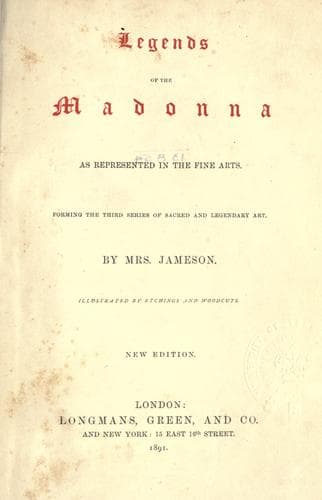
Legends of the Madonna as Represented in the Fine ArtsJameson, Mrs. (Anna)
Religion
Legends of the Madonna as Represented in the Fine Arts
Jameson, Mrs. (Anna)
Christian saints in art; Mary, Blessed Virgin, Saint -- Art; Mary, Blessed Virgin, Saint -- Legends
"Oh, Virgin-Mother, daughter of thy Son!
Created beings all in lowliness
Surpassing, as in height above them all;
Term by the eternal counsel preordain'd;
Ennobler of thy nature, so advanc'd
In thee, that its great Maker did not scorn
To make himself his own creation;
For in thy womb, rekindling, shone the love
Reveal'd, whose genial influence makes now
This flower to germin in eternal peace:
Here thou, to us, of charity and love
Art as the noon-day torch; and art beneath,
To mortal men, of hope a living spring.
So mighty art thou, Lady, and so great,
That he who grace desireth, and comes not
To thee for aidance, fain would have desire
Fly without wings. Not only him who asks,
Thy bounty succours; but doth freely oft
Forerun the asking. Whatsoe'er may be
Of excellence in creature, pity mild,
Relenting mercy, large munificence,
Are all combin'd in thee!"
It is interesting to turn to the corresponding stanzas in Chaucer.
The invocation to the Virgin with which he commences the story of St.
Cecilia is rendered almost word for word from Dante:--
"Thou Maid and Mother, daughter of thy Son!
Thou wel of mercy, sinful soules cure!"
The last stanza of the invocation is his own, and as characteristic of
the practical Chaucer, as it would have been contrary to the genius of
Dante:--
"And for that faith is dead withouten workis,
So for to worken give me wit and grace!
That I be quit from thence that most dark is;
O thou that art so fair and full of grace,
Be thou mine advocate in that high place,
There, as withouten end is sung Hozanne,
Thou Christes mother, daughter dear of Anne!"
Still more beautiful and more his own is the invocation in the
"Prioress's Tale." I give the stanzas as modernized by Wordsworth:--
"O Mother Maid! O Maid and Mother free!
O bush unburnt, burning in Moses' sight!
That down didst ravish from the Deity,
Through humbleness, the Spirit that that did alight
Upon thy heart, whence, through that glory's might
Conceived was the Father's sapience,
Help me to tell it in thy reverence!
"Lady, thy goodness, thy magnificence,
Thy virtue, and thy great humility,
Surpass all science and all utterance;
For sometimes, Lady! ere men pray to thee,
Thou go'st before in thy benignity,
The light to us vouchsafing of thy prayer,
To be our guide unto thy Son so dear.
"My knowledge is so weak, O blissful Queen,
To tell abroad thy mighty worthiness,
That I the weight of it may not sustain;
But as a child of twelve months old, or less,
That laboureth his language to express,
Even so fare I; and therefore, I thee pray,
Guide thou my song, which I of thee shall say."
And again, we may turn to Petrarch's hymn to the Virgin, wherein
he prays to be delivered from his love and everlasting regrets for
Laura:--
"Vergine bella, che di sol vestita,
Coronata di stelle, al sommo Sole
Piacesti sì, che'n te sua luce ascose.
Public-domain text, read in full here on John Shaqi.
Reviews
Reviews
No reviews yet
Be the first to share your thoughts on this work.
Join the Discussion
Join the discussion
Sign in to leave a comment or review.
Sign InorCreate an account