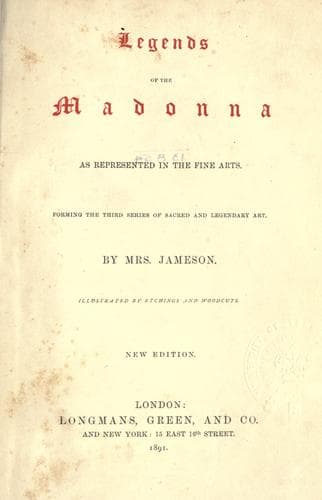
Legends of the Madonna as Represented in the Fine Arts — John Shaqi
Legends of the Madonna as Represented in the Fine ArtsJameson, Mrs. (Anna)
Religion
Legends of the Madonna as Represented in the Fine Arts
Jameson, Mrs. (Anna)
Christian saints in art; Mary, Blessed Virgin, Saint -- Art; Mary, Blessed Virgin, Saint -- Legends
"Vergine pura, d'ogni parte intera,
Del tuo parto gentil figliuola e madre!
"Vergine sola al mondo senza esempio,
Che 'l ciel di tue bellezze innamorasti."
The fancy of the theologians of the middle ages played rather
dangerously, as it appears to me, for the uninitiated and
uninstructed, with the perplexity of these divine relationships. It is
impossible not to feel that in their admiration for the divine beauty
of Mary, in borrowing the amatory language and luxuriant allegories
of the Canticles, which represent her as an object of delight to the
Supreme Being, theologians, poets, and artists had wrought themselves
up to a wild pitch of enthusiasm. In such passages as those I have
quoted above, and in the grand old Church hymns, we find the best
commentary and interpretation of the sacred pictures of the fourteenth
and fifteenth centuries. Yet during the thirteenth century there was
a purity in the spirit of the worship which at once inspired and
regulated the forms in which it was manifested. The Annunciations and
Nativities were still distinguished by a chaste and sacred simplicity.
The features of the Madonna herself, even where they were not what we
call beautiful, had yet a touch of that divine and contemplative grace
which the theologians and the poets had associated with the queenly,
maternal, and bridal character of Mary.
Thus the impulses given in the early part of the fourteenth century
continued in progressive development through the fifteenth; the
spiritual for some time in advance of the material influences; the
moral idea emanating as it were _from_ the soul, and the influences
of external nature flowing _into_ it; the comprehensive power of fancy
using more and more the apprehensive power of imitation, and both
working together till their "blended might" achieved its full fruition
in the works of Raphael.
* * * * *
Early in the fifteenth century, the Council of Constance (A.D. 1414),
and the condemnation of Huss, gave a new impulse to the worship of the
Virgin. The Hussite wars, and the sacrilegious indignity with which
her sacred images had been treated in the north, filled her orthodox
votaries of the south, of Europe with a consternation and horror
like that excited by the Iconoclasts of the eighth century, and were
followed by a similar reaction. The Church was called upon to assert
more strongly than ever its orthodox veneration for her, and, as a
natural consequence, votive pictures multiplied, the works of the
excelling artists of the fifteenth century testify to the zeal of the
votaries, and the kindred spirit in which the painters worked.
Public-domain text, read in full here on John Shaqi.
Reviews
Reviews
No reviews yet
Be the first to share your thoughts on this work.
Join the Discussion
Join the discussion
Sign in to leave a comment or review.
Sign InorCreate an account