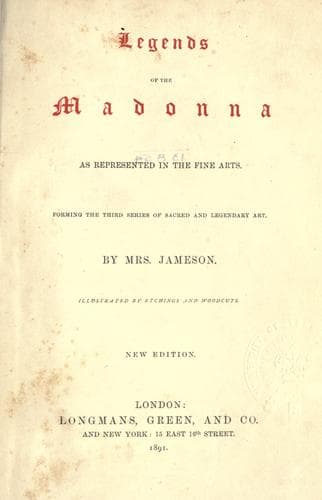
Legends of the Madonna as Represented in the Fine ArtsJameson, Mrs. (Anna)
Religion
Legends of the Madonna as Represented in the Fine Arts
Jameson, Mrs. (Anna)
Christian saints in art; Mary, Blessed Virgin, Saint -- Art; Mary, Blessed Virgin, Saint -- Legends
It is curious that, hand in hand with this development of taste and
feeling in the appreciation of natural sentiment and beauty, and
this tendency to realism, we find the associations of a peculiar and
specific sanctity remaining with the old Byzantine type. This arose
from the fact, always to be borne in mind, that the most ancient
artistic figure of the Madonna was a purely theological symbol;
apparently the moral type was too nearly allied to the human and
the real to satisfy faith. It is the ugly, dark-coloured, ancient
Greek Madonnas, such as this, which had all along the credit of
being miraculous; and "to this day," says Kugler, "the Neapolitan
lemonade-seller will allow no other than a formal Greek Madonna, with
olive-green complexion and veiled head, to be set up in his booth." It
is the same in Russia. Such pictures, in which there is no attempt
at representation, real or ideal, and which merely have a sort of
imaginary sanctity and power, are not so much idols as they are mere
_Fetishes_. The most lovely Madonna by Raphael or Titian would not
have the same effect. Guido, who himself painted lovely Virgins,
went every Saturday to pray before the little black _Madonna della
Guardia_, and, as we are assured, held this old Eastern relic in
devout veneration.
In the pictures of the Madonna, produced by the most eminent painters
of the seventeenth century, is embodied the theology of the time.
The Virgin Mary is not, like the Madonna di San Sisto, "a single
projection of the artist's mind," but, as far as he could put his
studies together, she is "a compound of every creature's best,"
sometimes majestic, sometimes graceful, often full of sentiment,
elegance, and refinement, but wanting wholly in the spiritual element.
If the Madonna did really sit to Guido in person, (see Malvasia,
"Felsina Pittrice,") we fancy she must have revealed her loveliness,
but veiled her divinity.
Without doubt the finest Madonnas of the seventeenth century are
those produced by the Spanish school; not because they more realize
our spiritual conception of the Virgin--quite the contrary: for here
the expression of life through sensation and emotion prevails over
abstract mind, grandeur, and grace;--but because the intensely human
and sympathetic character given to the Madonna appeals most strongly
to our human nature. The appeal is to the faith through the feelings,
rather than through the imagination. Morales and Ribera excelled
in the Mater Dolorosa; and who has surpassed Murilio in the tender
exultation of maternity?[1] There is a freshness and a depth of
feeling in the best Madonnas of the late Spanish school, which puts to
shame the mannerism of the Italians, and the naturalism of the Flemish
painters of the same period: and this because the Spaniards were
intense and enthusiastic believers, not mere thinkers, in art as in
religion.
Public-domain text, read in full here on John Shaqi.
Reviews
Reviews
No reviews yet
Be the first to share your thoughts on this work.
Join the Discussion
Join the discussion
Sign in to leave a comment or review.
Sign InorCreate an account