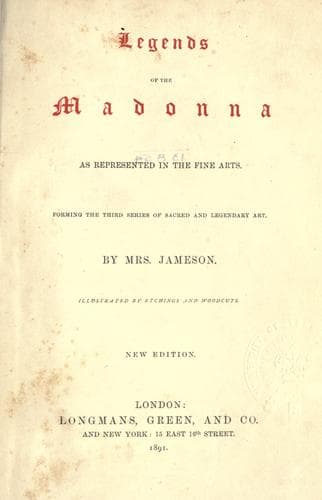
Legends of the Madonna as Represented in the Fine Arts — John Shaqi
Legends of the Madonna as Represented in the Fine ArtsJameson, Mrs. (Anna)
Religion
Legends of the Madonna as Represented in the Fine Arts
Jameson, Mrs. (Anna)
Christian saints in art; Mary, Blessed Virgin, Saint -- Art; Mary, Blessed Virgin, Saint -- Legends
But in the midst of these paganized and degenerate influences, the
reform in the discipline of the Roman Catholic Church was preparing
a revolution in religious art. The Council of Trent had severely
denounced the impropriety of certain pictures admitted into churches:
at the same time, in the conflict of creed which now divided
Christendom, the agencies of art could not safely be neglected by that
Church which had used them with such signal success. Spiritual art
was indeed no more. It was dead: it could never be revived without
a return to those modes of thought and belief which had at first
inspired it. Instead of religious art, appeared what I must call
_theological_ art. Among the events of this age, which had great
influence on the worship and the representations of the Madonna,
I must place the battle of Lepanto, in 1571, in which the combined
fleets of Christendom, led by Don Juan of Austria, achieved a
memorable victory over the Turks. This victory was attributed by Pope
Pius V. to the especial interposition of the Blessed Virgin. A new
invocation was now added to her Litany, under the title of _Auxilium
Christianorum_; a new festival, that of the Rosary, was now added to
those already held in her honour; and all the artistic genius which
existed in Italy, and all the piety of orthodox Christendom, were now
laid under contribution to incase in marble sculpture, to enrich with
countless offerings, that miraculous house, which the angels had
borne over land and sea, and set down at Loretto; and that miraculous,
bejewelled, and brocaded Madonna, enshrined within it.
* * * * *
In the beginning of the seventeenth century, the Caracci school gave
a new impetus to religious, or rather, as it has been styled in
contradistinction, sacerdotal or theological art. If these great
painters had been remarkable merely for the application of new
artistic methods, for the success with which they combined the aims of
various schools--
"Di Michel Angiol la terribil via
E 'l vero natural di Tiziano,"
the study of the antique with the observation of real life,--their
works undoubtedly would never have taken such a hold on the minds of
their contemporaries, nor kept it so long. Everything to live must
have an infusion of truth within it, and this "patchwork ideal," as
it has been well styled, was held together by such a principle. The
founders of the Caracci school, and their immediate followers, felt
the influences of the time, and worked them out. They were devout
believers in their Church, and most sincere worshippers of the
Madonna. Guido, in particular, was so distinguished by his passionate
enthusiasm for her, that he was supposed to have been favoured by a
particular vision, which enabled him more worthily to represent her
divine beauty.
Public-domain text, read in full here on John Shaqi.
Reviews
Reviews
No reviews yet
Be the first to share your thoughts on this work.
Join the Discussion
Join the discussion
Sign in to leave a comment or review.
Sign InorCreate an account