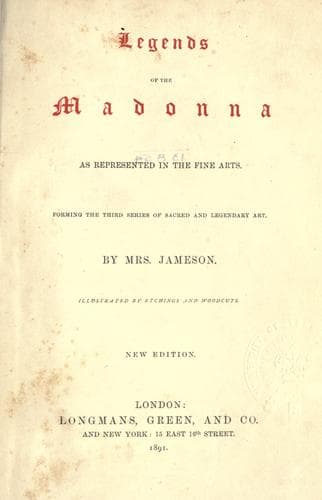
Legends of the Madonna as Represented in the Fine ArtsJameson, Mrs. (Anna)
Religion
Legends of the Madonna as Represented in the Fine Arts
Jameson, Mrs. (Anna)
Christian saints in art; Mary, Blessed Virgin, Saint -- Art; Mary, Blessed Virgin, Saint -- Legends
After this rapid sketch of the influences which modified in a general
way the pictures of the Madonna, we may array before us, and learn to
compare, the types which distinguished in a more particular manner the
separate schools, caught from some more local or individual impulses.
Thus we have the stern, awful quietude of the old Mosaics; the hard
lifelessness of the degenerate Greek; the pensive sentiment of
the Siena, and stately elegance of the Florentine Madonnas; the
intellectual Milanese, with their large foreheads and thoughtful eyes;
the tender, refined mysticism of the Umbrian; the sumptuous loveliness
of the Venetian; the quaint, characteristic simplicity of the early
German, so stamped with their nationality, that I never looked round
me in a room full of German girls without thinking of Albert Durer's
Virgins; the intense life-like feeling of the Spanish; the prosaic,
portrait-like nature of the Flemish schools, and so on. But here an
obvious question suggests itself. In the midst of all this diversity,
these ever-changing influences, was there no characteristic type
universally accepted, suggested by common religious associations, if
not defined by ecclesiastical authority, to which the artist was bound
to conform? How is it that the impersonation of the Virgin fluctuated,
not only with the fluctuating tendencies of successive ages, but even
with the caprices of the individual artist?
This leads us back to reconsider the sources from which the artist
drew his inspiration.
The legend which represents St. Luke the Evangelist as a painter
appears to be of Eastern origin, and quite unknown in Western Europe
before the first crusade. It crept in then, and was accepted with many
other oriental superstitions and traditions. It may have originated
in the real existence of a Greek painter named Luca--a saint, too,
he may have been; for the Greeks have a whole calendar of canonized
artists,--painters, poets, and musicians; and this Greek San Luca may
have been a painter of those Madonnas imported from the ateliers of
Mount Athos into the West by merchants and pilgrims; and the West,
which knew but of one St. Luke, may have easily confounded the painter
and the evangelist.
Public-domain text, read in full here on John Shaqi.
Reviews
Reviews
No reviews yet
Be the first to share your thoughts on this work.
Join the Discussion
Join the discussion
Sign in to leave a comment or review.
Sign InorCreate an account