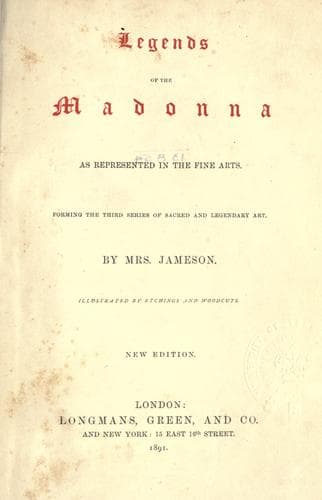
Legends of the Madonna as Represented in the Fine ArtsJameson, Mrs. (Anna)
Religion
Legends of the Madonna as Represented in the Fine Arts
Jameson, Mrs. (Anna)
Christian saints in art; Mary, Blessed Virgin, Saint -- Art; Mary, Blessed Virgin, Saint -- Legends
But we must also remember, that St. Luke the Evangelist was early
regarded as the great authority with respect to the few Scripture
particulars relating to the character and life of Mary; so that,
in the figurative sense, he may be said to have _painted_ that
portrait of her which has been since received as the perfect type
of womanhood:--1. Her noble, trustful humility, when she receives
the salutation of the angel (Luke i. 38); the complete and feminine
surrender of her whole being to the higher, holier will--"Be it unto
me according to thy word." 2. Then, the decision and prudence of
character, shown in her visit to Elizabeth, her older relative; her
journey in haste over the hills to consult with her cousin, which
journey it is otherwise difficult to accord with the oriental customs
of the time, unless Mary, young as she was, had possessed unusual
promptitude and energy of disposition. (Luke i. 39, 40.) 3. The proof
of her intellectual power in the beautiful hymn she has left us, "_My
soul doth magnify the Lord._" (Luke i. 46.) The commentators are
not agreed as to whether this effusion was poured forth by immediate
inspiration, or composed and written down, because the same words,
"and Mary said," may be interpreted in either sense; but we can no
more doubt her being the authoress, than we can doubt of any other
particulars recorded in the same Gospel: it proves that she must have
been, for her time and country, most rarely gifted in mind, and deeply
read in the Scriptures. 4. She was of a contemplative, reflecting,
rather silent disposition. "She kept all these sayings, and pondered
them in her heart." (Luke ii. 51.) She made no boast of that wondrous
and most blessed destiny to which she was called; she thought upon it
in silence. It is inferred that as many of these sayings and events
could be known to herself alone, St. Luke the Evangelist could have
learned them only from her own lips. 5. Next her truly maternal
devotion to her divine Son, whom she attended humbly through his whole
ministry;[1] 6. and lastly, the sublime fortitude and faith with which
she followed her Son to the death scene, stood beside the cross till
all was finished, and then went home, and _lived_ (Luke xxiii.); for
she was to be to us an example of all that a woman could endure, as
well as all that a woman could be and act out in her earthly life.
(John xix. 25.) Such was the character of Mary; such the _portrait_
really _painted_ by St. Luke; and, as it seems to me, these scattered,
artless, unintentional notices of conduct and character converge into
the most perfect moral type of the intellectual, tender, simple, and
heroic woman that ever was placed before us for our edification and
example.
[Footnote 1: Milton places in the mouth of our Saviour an allusion to
the influence of his Mother in early life:--
Public-domain text, read in full here on John Shaqi.
Reviews
Reviews
No reviews yet
Be the first to share your thoughts on this work.
Join the Discussion
Join the discussion
Sign in to leave a comment or review.
Sign InorCreate an account