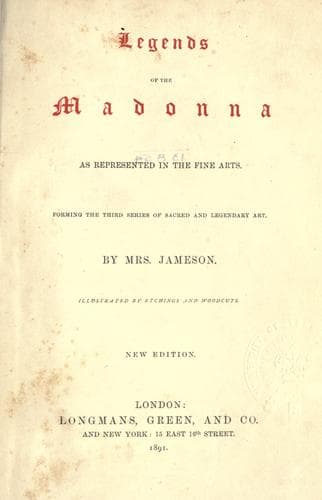
Legends of the Madonna as Represented in the Fine ArtsJameson, Mrs. (Anna)
Religion
Legends of the Madonna as Represented in the Fine Arts
Jameson, Mrs. (Anna)
Christian saints in art; Mary, Blessed Virgin, Saint -- Art; Mary, Blessed Virgin, Saint -- Legends
"These growing thoughts my mother soon perceiving
By words at times cast forth, duly rejoiced,
And said to me apart, 'High are thy thoughts,
O Son; but nourish them, and let them soar
To what height sacred virtue and true worth
Can raise them, though above example high.'"]
But in the Church traditions and enactments, another character
was, from the fifth century, assigned to her, out of which grew the
theological type, very beautiful and exalted, but absorbing to a great
degree the scriptural and moral type, and substituting for the merely
human attributes others borrowed from her relation to the great
scheme of redemption; for it was contended that, as the mother of
_the Divine_, she could not be herself less than divine; consequently
above the angels, and first of all created beings. According to the
doctrine of the Immaculate Conception, her tender woman's wisdom
became supernatural gifts; the beautiful humility was changed into a
knowledge of her own predestined glory; and, being raised bodily into
immortality, and placed beside her Son, in all "the sacred splendour
of beneficence," she came to be regarded as our intercessor before
that divine Son, who could refuse nothing to his mother. The relative
position of the Mother and Son being spiritual and indestructible was
continued in heaven; and thus step by step the woman was transmuted
into the divinity.
But, like her Son, Mary had walked in human form upon earth, and in
form must have resembled her Son; for, as it is argued, Christ had no
earthly father, therefore could only have derived his human lineaments
from his mother. All the old legends assume that the resemblance
between the Son and the Mother must have been perfect. Dante alludes
to this belief:
"Riguarda ormai nella faccia ch' a Christo
Piu s' assomiglia."
"Now raise thy view
Unto the visage most resembling Christ."
The accepted type of the head of Christ was to be taken as a model in
its mild, intellectual majesty, for that of the Virgin-mother, as far
as difference of sex would allow.
Public-domain text, read in full here on John Shaqi.
Reviews
Reviews
No reviews yet
Be the first to share your thoughts on this work.
Join the Discussion
Join the discussion
Sign in to leave a comment or review.
Sign InorCreate an account