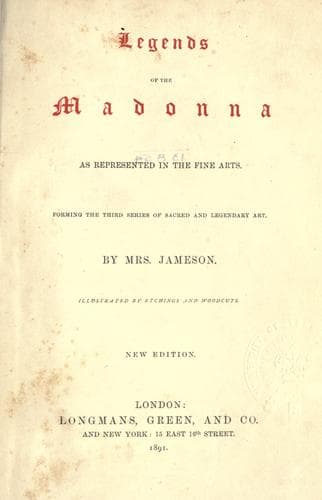
Legends of the Madonna as Represented in the Fine ArtsJameson, Mrs. (Anna)
Religion
Legends of the Madonna as Represented in the Fine Arts
Jameson, Mrs. (Anna)
Christian saints in art; Mary, Blessed Virgin, Saint -- Art; Mary, Blessed Virgin, Saint -- Legends
In the beautiful frescoes of the church of St. Apollinaris at Remagen,
these Hebrew women stand together in a group below the throne of the
Virgin.
Of the Prophets and the Sibyls who attend on Christ in his character
of the Messiah or Redeemer, I shall have much to say, when describing
the artistic treatment of the history and character of Our Lord.
Those of the prophets who are supposed to refer more particularly to
the Incarnation, properly attend on the Virgin and Child; but in the
ancient altar-pieces, they are not placed within the same frame, nor
are they grouped immediately round her throne, but form the outer
accessories, or are treated separately as symbolical.
First, MOSES, because he beheld the burning bush, "which burned and
was not consumed." He is generally in the act of removing his sandals.
AARON, because his rod blossomed miraculously.
GIDEON, on whose fleece descended the dew of heaven, while all was
dry around.
DANIEL, who beheld the stone which was cut out without hands, and
became a great mountain, filling the earth. (ch. ii. 45.)
DAVID, as prophet and ancestor. "Listen, O daughter, and incline thine
ear."
ISAIAH, "Behold a virgin shall conceive and bear a son."
EZEKIEL, "This gate shall be shut." (ch. xliv. 2.)
Certain of these personages, Moses, Aaron, Gideon, Daniel, Ezekiel,
are not merely accessories and attendant figures, but in a manner
attributes, as expressing the character of the Virgin. Thus in many
instances, we find the prophetical personages altogether omitted, and
we have simply the attribute figuring the prophecy itself, the burning
bush, the rod, the dewy fleece, &c.
The Sibyls are sometimes introduced alternately with the Prophets. In
general, if there be only two, they are the Tiburtina, who showed the
vision to Augustus, and the Cumean Sibyl who foretold the birth of our
Saviour. The Sibyls were much the fashion in the classic times of the
sixteenth century; Michael Angelo and Raphael have left us consummate
examples.
But I must repeat that the full consideration of the Prophets and
Sibyls as accessories belongs to another department of sacred art, and
they will find their place there.
The Evangelists frequently, and sometimes one or more of the
Twelve Apostles, appear as accessories which assist the theological
conception. When other figures are introduced, they are generally
either the protecting saints of the country or locality, or the saints
of the Religious Order to whom the edifice belongs: or, where the
picture or window is an _ex-voto_, we find the patron saints of the
confraternity, or of the donor or votary who has dedicated it.
Public-domain text, read in full here on John Shaqi.
Reviews
Reviews
No reviews yet
Be the first to share your thoughts on this work.
Join the Discussion
Join the discussion
Sign in to leave a comment or review.
Sign InorCreate an account