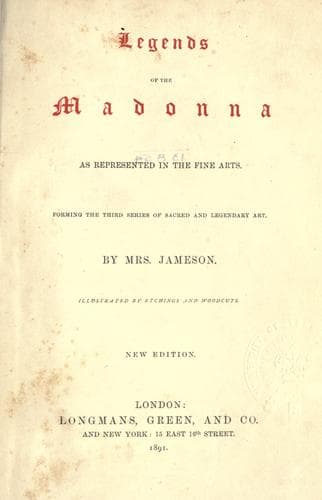
Legends of the Madonna as Represented in the Fine Arts — John Shaqi
Legends of the Madonna as Represented in the Fine ArtsJameson, Mrs. (Anna)
Religion
Legends of the Madonna as Represented in the Fine Arts
Jameson, Mrs. (Anna)
Christian saints in art; Mary, Blessed Virgin, Saint -- Art; Mary, Blessed Virgin, Saint -- Legends
Angels seated at the feet of the Madonna and playing on musical
instruments, are most lovely and appropriate accessories, for the
choral angels are always around her in heaven, and on earth she is
the especial patroness of music and minstrelsy.[1] Her delegate
Cecilia patronized _sacred_ music; but _all_ music and musicians,
all minstrels, and all who plied the "gaye science," were under the
protection of Mary. When the angels are singing from their music
books, and others are accompanying them with lutes and viols, the
song is not always supposed to be the same. In a Nativity they sing
the "Gloria in excelsis Deo;" in a Coronation, the "Regina Coeli;"
in an enthroned Madonna with votaries, the "Salve Regina, Mater
Misericordiæ!" in a pastoral Madonna and Child it may be the "Alma
Mater Redemptoris."
[Footnote 1: The picture by Lo Spagna, lately added to our National
Gallery, is a beautiful example.]
* * * * *
In all the most ancient devotional effigies (those in the catacombs
and the old mosaics), the Virgin appears as a majestic woman of mature
age. In those subjects taken from her history which precede her return
from Egypt, and in the Holy Families, she should appear as a young
maiden from fifteen to seventeen years old.
In the subjects taken from her history which follow the baptism of our
Lord, she should appear as a matron between forty and fifty, but still
of a sweet and gracious aspect. When Michael Angelo was reproached
with representing his Mater Dolorosa much too young, he replied that
the perfect virtue and serenity of the character of Mary would have
preserved her beauty and youthful appearance long beyond the usual
period.[1]
[Footnote 1: The group in St. Peter's, Rome.]
Because some of the Greek pictures and carved images had become black
through extreme age, it was argued by certain devout writers, that the
Virgin herself must have been of a very dark complexion; and in favour
of this idea they quoted this text from the Canticles, "I am black,
but comely, O ye daughters of Jerusalem." But others say that her
complexion had become black only during her sojourn in Egypt. At all
events, though the blackness of these antique images was supposed to
enhance their sanctity, it has never been imitated in the fine arts,
and it is quite contrary to the description of Nicephorus, which is
the most ancient authority, and that which is followed in the Greek
school.
Public-domain text, read in full here on John Shaqi.
Reviews
Reviews
No reviews yet
Be the first to share your thoughts on this work.
Join the Discussion
Join the discussion
Sign in to leave a comment or review.
Sign InorCreate an account