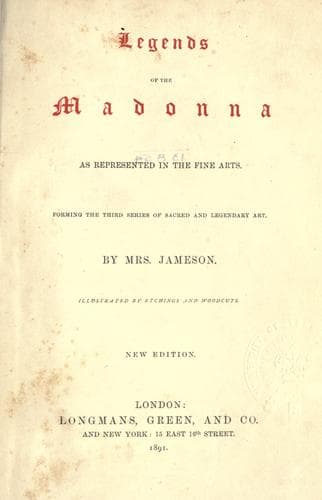
Legends of the Madonna as Represented in the Fine ArtsJameson, Mrs. (Anna)
Religion
Legends of the Madonna as Represented in the Fine Arts
Jameson, Mrs. (Anna)
Christian saints in art; Mary, Blessed Virgin, Saint -- Art; Mary, Blessed Virgin, Saint -- Legends
In the early pictures which represent her as nursing the divine Infant
(the subject called the _Vergine Lattante_), the utmost care is taken
to veil the bust as much as possible. In the Spanish school the most
vigilant censorship was exercised over all sacred pictures, and, with
regard to the figures of the Virgin, the utmost decorum was required.
"What," says Pacheco, "can be more foreign to the respect which we owe
to our Lady the Virgin, than to paint her sitting down with one of her
knees placed over the other, and often with her sacred feet uncovered
and naked? Let thanks be given to the Holy Inquisition, which commands
that this liberty should be corrected." For this reason, perhaps, we
seldom see the feet of the Virgin in Spanish pictures.[1] Carducho
speaks more particularly on the impropriety of painting the Virgin
unshod, "since it is manifest that, our Lady was in the habit of
wearing shoes, as is proved by the much venerated relic of one of them
from her divine feet at Burgos."
[Footnote 1: Or in any of the old pictures till the seventeenth
century "Tandis que Dieu est toujours montré pieds nus, lui qui est
descendu à terre et a pris notre humanité, Marie au contraire est
constamment représentée les pieds perdus dans les plis trainants,
nombreux et légers de sa robe virginale; elle, qui est elevée au
dessus de la terre et rapprochée de Dieu par sa pureté. Dieu montre
par ses pieds nus qu'il a pris le corps de l'homme; Marie fait
comprendre en les cachant qu'elle participe de la spiritualité de
Dieu."]
The Child in her arms is always, in the Greek and early pictures,
clothed in a little tunic, generally white. In the fifteenth century
he first appears partly, and then wholly, undraped. Joseph, as the
earthly _sposo_, wears the saffron-coloured mantle over a gray tunic.
In the later schools of art these significant colours are often
varied, and sometimes wholly dispensed with.
III. DEVOTIONAL AND HISTORICAL REPRESENTATIONS.
In this volume, as in the former ones, I have adhered to the
distinction between the devotional and the historical representations.
I class as devotional, all those which express a dogma merely; all the
enthroned Madonnas, alone or surrounded by significant accessories
or attendant saints; all the Mystical Coronations and Immaculate
Conceptions; all the Holy Families with saints, and those completely
ideal and votive groups, in which the appeal is made to the faith and
piety of the observer. I shall give the characteristic details, in
particular instances, further on.
Public-domain text, read in full here on John Shaqi.
Reviews
Reviews
No reviews yet
Be the first to share your thoughts on this work.
Join the Discussion
Join the discussion
Sign in to leave a comment or review.
Sign InorCreate an account