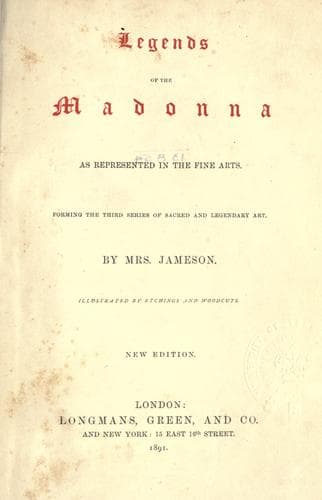
Legends of the Madonna as Represented in the Fine ArtsJameson, Mrs. (Anna)
Religion
Legends of the Madonna as Represented in the Fine Arts
Jameson, Mrs. (Anna)
Christian saints in art; Mary, Blessed Virgin, Saint -- Art; Mary, Blessed Virgin, Saint -- Legends
The proper dress of the Virgin is a close red tunic, with long
sleeves;[1] and over this a blue robe or mantle. In the early
pictures, the colours are pale and delicate. Her head ought to be
veiled. The fathers of the primeval Church, particularly Tertullian,
attach great importance to the decent veil worn by Christian maidens;
and in all the early pictures the Virgin is veiled. The enthroned
Virgin, unveiled, with long tresses falling down on either side,
was an innovation introduced about the end of the fifteenth century;
commencing, I think, with the Milanese, and thence adopted in the
German schools and those of Northern Italy. The German Madonnas of
Albert Durer's time have often magnificent and luxuriant hair, curling
in ringlets, or descending to the waist in rich waves, and always
fair. Dark-haired Madonnas appear first in the Spanish and later
Italian schools.
[Footnote 1: In a famous Pietà by Raphael, engraved by Marc Antonio,
the Virgin, standing by the dead form of her Son, has the right arm
apparently bare; in the repetition of the subject it is clothed with
a full sleeve, the impropriety being corrected. The first is, however,
the most perfect and most precious as a work of art.--_Bartsch_, xiv.
34, 35.]
In the historical pictures, her dress is very simple; but in those
devotional figures which represent her as queen of heaven, she wears a
splendid crown, sometimes of jewels interwoven with lilies and roses.
The crown is often the sovereign crown of the country in which the
picture is placed: thus, in the Papal States, she often wears the
triple tiara: in Austria, the imperial diadem. Her blue tunic is
richly embroidered with gold and gems, or lined with ermine, or stuff
of various colours, in accordance with a text of Scripture: "The
King's daughter is all glorious within; her clothing is of wrought
gold. She shall be brought unto the King in a vesture of needlework."
(Ps. xlv. 13.) In the Immaculate Conception, and in the Assumption,
her tunic should be plain white, or white spangled with golden stars.
In the subjects relating to the Passion, and after the Crucifixion,
the dress of the Virgin should be violet or gray. These proprieties,
however, are not always attended to.
Public-domain text, read in full here on John Shaqi.
Reviews
Reviews
No reviews yet
Be the first to share your thoughts on this work.
Join the Discussion
Join the discussion
Sign in to leave a comment or review.
Sign InorCreate an account