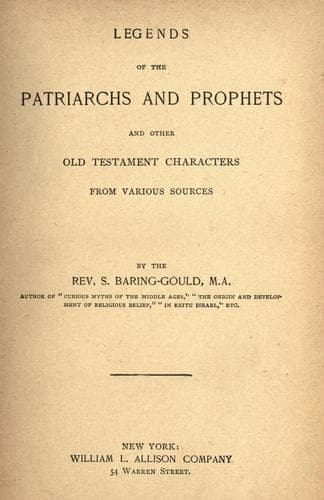
Legends of the Patriarchs and Prophets: And Other Old Testament Characters from Various SourcesBaring-Gould, S. (Sabine)
Religion
Legends of the Patriarchs and Prophets: And Other Old Testament Characters from Various Sources
Baring-Gould, S. (Sabine)
Bible. Old Testament -- Legends
LEGENDS
OF THE
PATRIARCHS AND PROPHETS.
LEGENDS
OF THE
PATRIARCHS AND PROPHETS
AND OTHER
OLD TESTAMENT CHARACTERS
FROM VARIOUS SOURCES
BY THE
REV. S. BARING-GOULD, M.A.
_Author of “Curious Myths of the Middle Ages,” “The Origin and
Development of Religious Belief,” “In Exitu Israel,” etc._
[Publisher's Logo]
NEW YORK:
AMERICAN BOOK EXCHANGE,
764 BROADWAY.
1881.
PREFACE.
An incredible number of legends exists connected with the personages
whose history is given in the Old Testament. The collection now
presented to the public must by no means be considered as exhaustive.
The compiler has been obliged to limit himself as to the number, it
being quite impossible to insert all. He trusts that few of peculiar
interest have been omitted.
The Mussulman traditions are nearly all derived from the Talmudic
writers, just as the history of Christ in the Koran is taken from the
Apocryphal Gospels. The Koran follows the “Sepher Hajaschar” (Book
of the Just) far more closely than the canonical Scriptures; and the
“Sepher Hajaschar” is a storehouse of the Rabbinic tradition on the
subject of the Patriarchs from Adam to Joshua.
The Jewish traditions are of various value. Some can be traced to
their origin without fail. One class is derived from Persia, as, for
instance, those of Asmodeus, the name of the demon being taken, along
with his story, from Iranian sources. Another class springs from the
Cabbalists, who, by permutation of the letters of a name, formed the
nuclei, so to speak, from which legends spread.
Another class, again, is due to the Rabbinic commentators, who, unable
to allow for poetical periphrasis, insisted on literal interpretations,
and then coined fables to explain them. Thus the saying of David,
“_Thou hast heard me from among the horns of the unicorns_,” which
signified that David was assisted by God in trouble, was taken quite
literally by the Rabbis, and a story was invented to explain it.
Another class, again, is no doubt due to the exaggeration of Oriental
imagery, just as that previously mentioned is due to the deficiency of
the poetic fancy in certain Rabbis. Thus, imagination and defect of
imagination, each contributed to add to the store.
But when we have swept all these classes aside, there remains a
residuum, small, no doubt, of genuine tradition. To this class, if I am
not mistaken, belong the account of Lamech and his wives, and the story
of the sacrifice of Isaac. In the latter instance, the type comes out
far clearer in the Talmudic tradition that in the canonical Scriptures;
and this can hardly have been the result of Jewish interpolation,
knowing, as they did, that Christians pointed triumphantly to this type.
* * * * *
Public-domain text, read in full here on John Shaqi.
Reviews
Reviews
No reviews yet
Be the first to share your thoughts on this work.
Join the Discussion
Join the discussion
Sign in to leave a comment or review.
Sign InorCreate an account