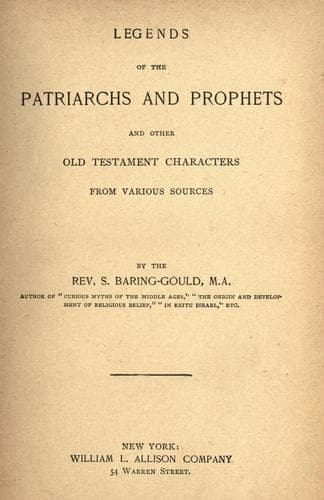
Legends of the Patriarchs and Prophets: And Other Old Testament Characters from Various SourcesBaring-Gould, S. (Sabine)
Religion
Legends of the Patriarchs and Prophets: And Other Old Testament Characters from Various Sources
Baring-Gould, S. (Sabine)
Bible. Old Testament -- Legends
The king and his nobles were dismayed. They thought that this action
augured evil to the king through the child that was before them. Then
Balaam, the son of Beor, lifted up his voice and said, “My lord and
king! dost thou not remember the interpretation of thy dream, as thy
servant interpreted it to thee? This child is of Hebrew extraction,
and is wiser and more cunning than befits his age. When he is old he
will take thy crown from off thy head, and will tread the power of
Egypt under his feet. Thus have his ancestors ever done. Abraham defied
Nimrod, and rent from him Canaan, a portion of his kingdom. Isaac
prevailed over the king of the Philistines. Jacob took from his brother
his birthright and blessing, and smote the Hivites and their king
Hamor. Joseph, the slave, became chief in his realm, and gave the best
of this land to his father and his brethren. And now this child will
take from thee the kingdom, and will enslave or destroy thy people.
There is no expedient for thee but to slay him, that Egypt become not
his prey.”
But Pharaoh said, “We will take other counsel, Balaam, before we decide
what shall be done with this child.”
Then some advised that he should be burnt with fire, and others that he
should be slain with the sword. But the angel Gabriel, in the form of
an old man, mingled with the councillors, and said, “Let not innocent
blood be shed. The child is too young to know what he is doing. Prove
whether he has any understanding and design, before you sentence him. O
king! let a bowl of live coals and a bowl of precious stones be brought
to the little one. If he takes the stones, then he has understanding,
and discerns between good and evil; but if he thrusts his hands towards
the burning coals, then he is innocent of purpose and devoid of
reason.”[472]
This advice pleased the king, and he gave orders that it should be as
the angel had recommended.
Now when the basins were brought in and offered to Moses, he thrust
out his hand towards the jewels. But Gabriel, who had made himself
invisible, caught his hand and directed it towards the red-hot coals;
and Moses burnt his fingers, and he put them into his mouth, and burnt
his lips and tongue; and therefore it is that Moses said, in after
days, “I am slow of lips and slow of tongue.”[473]
Pharaoh and his council were now convinced of the simplicity of Moses,
and no harm was done him. Then Bithia removed him, and brought him up
in her own part of the palace.
God was with him, and he increased in stature and beauty, and Pharaoh’s
heart was softened towards him. He went arrayed in purple through the
streets, as the son of Bithia, and a chaplet of diamonds surrounded his
brows, and he consorted only with princes. When he was five years old,
he was in size and knowledge as advanced as a boy of twelve.
Public-domain text, read in full here on John Shaqi.
Reviews
Reviews
No reviews yet
Be the first to share your thoughts on this work.
Elsewhere in the archive
Join the Discussion
Join the discussion
Sign in to leave a comment or review.
Sign InorCreate an account