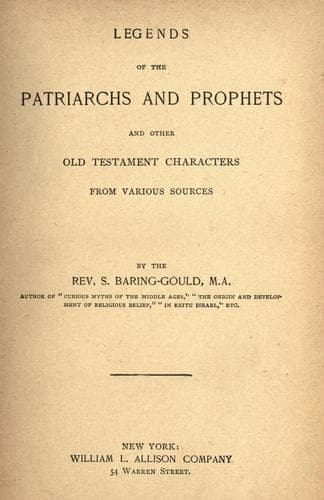
Legends of the Patriarchs and Prophets: And Other Old Testament Characters from Various SourcesBaring-Gould, S. (Sabine)
Religion
Legends of the Patriarchs and Prophets: And Other Old Testament Characters from Various Sources
Baring-Gould, S. (Sabine)
Bible. Old Testament -- Legends
God then made the animals subject to death, but the men He made were
immortal. But the new created men became disobedient, as had the first
creatures; and the frog complained to Him of His injustice in having
made the harmless animals subject to death, but guilty man deathless.
“Thou art right,” answered Til, and He cast on the men He had made, old
age, sickness, and death.[73]
The Fantis relate that they are not in the same condition as that in
which they were made, for their first parents had been placed in a
lofty and more suitable country, but God drave them into an inferior
habitation, that they might learn humility. On the Gold Coast the
reason of the Fall is said to have been that the first men were offered
the choice of gold or of wisdom, and they chose the former.[74]
In Ashantee the story is thus told. In the beginning, God created three
white and three black men and women, and gave them the choice between
good and evil. A great calabash was placed on the earth, as also a
sealed paper, and God gave the black men the first choice. They took
the calabash, thinking it contained every thing, and in it were only a
lump of gold, a bar of iron, and some other metals. The white men took
the sealed paper, in which they learned every thing. So God left the
black men in the bush and took the white men to the sea, and He taught
them how to build ships and go into another land. This fall from God
caused the black men to worship the subsidiary Fetishes instead of
Him.[75]
In Greenland “the first man is said to have been Kallak. He came out
of the earth, but his wife issued from his thumb, and from them all
generations of men have sprung. To him many attribute the origin of all
things. The woman brought death into the world, in that she said, Let
us die to make room for our successors.”[76]
The tradition of the Dog-rib Indians near the Polar Sea, as related by
Sir J. Franklin in his account of his expedition of 1825-27, is that
the first man was called Tschäpiwih. He found the earth filled with
abundance of all good things. He begat children and he gave to them two
sorts of fruit, one white and the other black, and he bade them eat
the white, but eschew the black. And having given them this command,
he left them and went a long journey to fetch the sun to enlighten the
world. During his absence they ate only of the white fruit, and then
the father made a second journey to fetch the moon, leaving them well
provided with fruit. But after a while they forgot his command, and
consumed the black fruit. On his return he was angry, and cursed the
ground that it should thenceforth produce only the black fruit, and
that with it should come in sickness and death.
Public-domain text, read in full here on John Shaqi.
Reviews
Reviews
No reviews yet
Be the first to share your thoughts on this work.
Join the Discussion
Join the discussion
Sign in to leave a comment or review.
Sign InorCreate an account