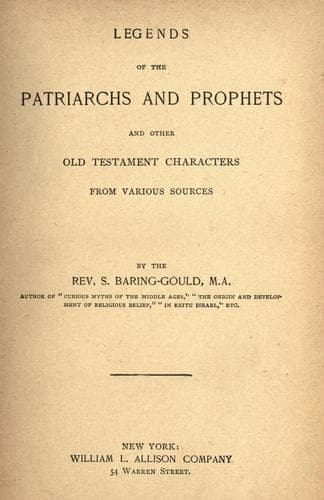
Legends of the Patriarchs and Prophets: And Other Old Testament Characters from Various Sources — John Shaqi
Legends of the Patriarchs and Prophets: And Other Old Testament Characters from Various SourcesBaring-Gould, S. (Sabine)
Religion
Legends of the Patriarchs and Prophets: And Other Old Testament Characters from Various Sources
Baring-Gould, S. (Sabine)
Bible. Old Testament -- Legends
Dr. Hunter, in his “Memoirs of Captivity amongst the Indians,” says
that the Delawares believe that in the beginning the Red men had short
tails, but they blasphemed the Great Spirit, and in punishment for
their sin their tails were cut off and transformed into women, to be
their perpetual worry. The same story is told by Mr. Atherne Jones, as
heard by him among the Kikapoos.
The ancient Mexicans had a myth of Xolotl, making out of a man’s bone
the primeval mother in the heavenly Paradise; and he called the woman
he had made Cihuacouhatl, which means “The woman with the serpent,” or
Quilatzli, which means “The woman of our flesh.” She was the mother of
twins, and is represented in a Mexican hieroglyph as speaking with the
serpent, whilst behind her stand the twins, whose different characters
are represented by different colors, one of whom is represented
slaying the other.[77] Xolotl, who made her out of a bone, was cast
out of heaven and became the first man. That the Mexicans had other
traditions, now lost, touching this matter is probable, for they had a
form of baptism for children in which they prayed that those baptized
might be washed from “the original sin committed before the founding of
the world.” And this had to do, in all probability, with a legend akin
to that of the Iroquois, who told of the primeval mother falling, and
then of the earth being built up to receive her, when precipitated out
of heaven.
The Caribs of South America relate that Luoguo, the first man and
god, created the earth and the sea, and made the earth as fair as the
beautiful garden in the heaven where dwell the gods. Luoguo dwelt
among the men he had made for some while. He drew the men out of his
navel and out of his thigh which he cut open. One of the first men was
Racumon, who was transformed into a great serpent with a human head,
and he lived twined round a great Cabatas tree and ate of its fruit,
and gave to those who passed by. Then the Caribs lived to a great age,
and never waxed old or died. Afterwards they found a garden planted
with manioc, and on that they fed. But they became wicked, and a flood
came and swept them away.[78]
In the South Sea Islands we find other traditions of the Fall. In Alea,
one of the Caroline Islands, the tale runs thus:--
“The sister of Eliulap the first man, who was also a god, felt herself
in labor, so she descended to earth and there brought forth three
children. To her astonishment she found the earth barren; therefore by
her mighty word, she clothed it with herbage and peopled it with beasts
and birds. And the world became very beautiful, and her sons were happy
and did not feel sickness or death, but at the close of every month
fell into a slumber from which they awoke renewed in strength and
beauty. But Erigeres, the bad spirit, envied this happiness, so he came
to the world and introduced into it pain, age, and death.”[79]
With the Jewish additions to the story given in Genesis, we shall
conclude.
Public-domain text, read in full here on John Shaqi.
Reviews
Reviews
No reviews yet
Be the first to share your thoughts on this work.
Join the Discussion
Join the discussion
Sign in to leave a comment or review.
Sign InorCreate an account