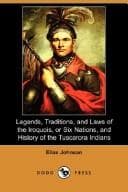
Legends, Traditions, and Laws of the Iroquois, or Six Nations, and History of the Tuscarora IndiansJohnson, Elias
History
Legends, Traditions, and Laws of the Iroquois, or Six Nations, and History of the Tuscarora Indians
Johnson, Elias
Iroquois Indians; Tuscarora Indians
I have written in somewhat of the spirit which will characterize a
History, by an Indian, yet it does not deserve to be called Indian
partiality, but only justice and the spirit of humanity; or, if I may be
allowed to say it, the spirit with which any christian should be able to
consider the character and deeds of his foe. I would not detract from the
virtues of your forefathers. They were at that time unrivalled, but
bigotry and superstition of the dark ages still lingered among them, and
their own perils blinded them to the wickedness and cruelty of the means
they took for defence.
Four, and perhaps two centuries hence, I doubt not, some of your dogmas
will seem unchristian, as the Indians seem to you, and I truly hope, ere
then, all wars will seem as barbarous, and the fantastic dress of the
soldiers as ridiculous, as you have been in the habit of representing the
wars and the wild drapery of the Indians of the forest.
How long were the Saxon and Celt in becoming a civilized and Christian
people? How long since the helmet, the coat of mail, and the battle axe,
were laid aside?
To make himself more terrific, the Briton of the days of Henry II drew
the skin of a wild beast over his armor with the head and ears standing
upright, and mounted his war-horse to go forth crying, "To arms! Death to
the invader!" The paint and the Eagle plume of the Indian warrior were
scarcely a more barbarous invention, nor his war-cry more terrible.
It is not just to compare the Indian of the fifteenth, with the christian
of the fifteenth century. But compare them with the barbarian of Britain,
of Russia, of Lapland, and Tartary, and represent them as truly as these
nations have been represented, and they will not suffer by the
comparison.
* * * * *
CAPTIVE'S LIFE AMONG INDIANS.
ILLUSTRATED BY THE LIFE OF THE "WHITE WOMAN."
* * * * *
To be taken captive by the Indians, was, among the early colonists,
considered the most terrible of all calamities, and it was indeed a
fearful thing to become the victim of their revenge. But those who were
enduring the actual sufferings of captivity, or suffering still more from
terror of uncertain evils, thought little of the provocation given by the
white people. The innocent suffered for the guilty, and however
persevering--I suppose the efforts of the government to be just--in its
infancy, in a wild unknown country it was impossible to control
unprincipled marauders. Some atrocious act was first committed by white
men, which drove the Indian to retaliation, and thinking pale faces were
all alike, he did not wait till the real offender fell into his hands.
Public-domain text, read in full here on John Shaqi.
Reviews
Reviews
No reviews yet
Be the first to share your thoughts on this work.
Join the Discussion
Join the discussion
Sign in to leave a comment or review.
Sign InorCreate an account