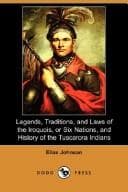
Legends, Traditions, and Laws of the Iroquois, or Six Nations, and History of the Tuscarora Indians — John Shaqi
Legends, Traditions, and Laws of the Iroquois, or Six Nations, and History of the Tuscarora IndiansJohnson, Elias
History
Legends, Traditions, and Laws of the Iroquois, or Six Nations, and History of the Tuscarora Indians
Johnson, Elias
Iroquois Indians; Tuscarora Indians
If all, or even a few who ministered among them in holy things, had been
like Eliot, who is called "the Apostle to the Indians," and deserved to
be ranked with the Apostle of old, or Kirkland, who is endeared to the
memory of every Iroquois who heard his name, it could not have become a
proverb or a truth that civilization and christianity wasted them away.
They were, not by one, but many, unscrupulously called "dogs, wolves,
bloodhounds, demons, devils incarnate, hellhounds, fiends, monsters,
beasts," always considering them inferior beings, and scarcely allowing
them to be human, yet one, who was at that time a captive among them,
represents them as "kind and loving and generous;" and concerning this
same monster--Philip--records nothing that should have condemned him in
the eyes of those who believed in wars aggressive and defensive, and
awarded honors to heroes and martyrs and conquerors.
By the Governor of Jamestown a hand was severed from the arm of a
peaceful, unoffending Indian, that he might be sent back a terror to his
people; and through the magnanimity of a daughter and king of that same
people, that colony was saved from destruction. It was through their love
and trust alone that Powhatan and Pocahontas lost their forest dominions.
Hospitality was one of the Indians' distinguishing virtues, and there was
no such thing among them as individual starvation or want. As long as
there was a cup of soup, it was divided. If a friend or a stranger made a
call he was welcome to all their wigwams would furnish, and to offer him
food was not merely a custom, for it was a breach of politeness for him
to refuse to eat however full he might be.
Because their system not being like the white people's, it does not
follow that it was not a system. You might have looked into the wigwam or
lodge and thought everything in confusion, while to the occupants, there
was a place for everything, and everything in its place: each had a couch
which answered for bed by night and seat by day. The ceremonies at their
festivals were as regular as in the churches, their rules of war as well
defined as those of christian nations, and in their games and athletic
sports there was a code of honor which it was disgraceful to violate:
their marriage vows were as well understood, and courtesy as formally
practiced at their dances.
The nature of the Indian is in all respects like the nature of any other
nation; placed in the same circumstances, he exhibits the same passions
and vices. But in his forest home there was not the same temptation to
great crimes, or what is termed the lesser ones, that of slander,
scandal, and gossip, as exists among civilized nations.
They knew nothing of the desire of gain, and therefore were not made
selfish by the love of hoarding; and there was no temptation to steal,
where they had everything in common, and their reverence for truth and
fidelity to promises, may well put all the nations of christendom to
shame.
Public-domain text, read in full here on John Shaqi.
Reviews
Reviews
No reviews yet
Be the first to share your thoughts on this work.
Join the Discussion
Join the discussion
Sign in to leave a comment or review.
Sign InorCreate an account