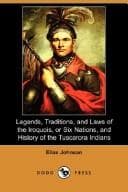
Legends, Traditions, and Laws of the Iroquois, or Six Nations, and History of the Tuscarora IndiansJohnson, Elias
History
Legends, Traditions, and Laws of the Iroquois, or Six Nations, and History of the Tuscarora Indians
Johnson, Elias
Iroquois Indians; Tuscarora Indians
A little book which professes to have been written for the sole purpose
of recording and perpetuating Indian atrocities, and dwells upon them
with infinite delight, alludes to this redeeming trait in Indian
character, but attempts to ascribe it to the influence of superstition,
as it were necessary to find some evil or deteriorating motive for
everything noble, or pleasing in Indian character. Their treatment of
captives from among Indian nations were the same. And I know not that
there has been any satisfactory solution of a characteristic which has
been found among only one other civilized christian or barbarous nation.
A wanderer among the Indian tribes once asked an Indian why they thus
honored their women, and he said "The Great Spirit taught, and would
punish us if we did not." Among the Germans I believed there existed the
same respect for woman, till they became civilized. They may have been
some superstitious fears mingled with a strong governing and controlling
principle, but it is not on this account the less marvelous that whole
nations, consisting of millions, should have been so trained, religiously
or domestically, that degree of beauty or fascination placed under their
care, though hundreds of miles in the solitudes of the wilderness, should
have tempted them from the strictest honor and the most delicate
kindness. MARY JANISON was eighty years a resident among the Senecas, and
in the early part of the time the forests had few clearings, and the
comforts and the vices of white men prevailed but little among them. She
was born on the ocean, with the billowy sea for her cradle, and the
tempest for her lullaby. Her parents emigrated from England to this
country in 1742, and settled in the unfortunate vale of Wyoming, where
date her first remembrances, which were all the woes that fell upon her
family, the wail of the sorrow-stricken and breaking of heart-strings.
The last meal they took together was a breakfast, after which the father
and eldest three sons went into the field, and Mary with the other
little children was playing not far from the house. They were suddenly
startled by a shriek, and knew it must be from their mother. On running
in they saw her in the hands of two Indians, who were holding her fast. A
little boy ran to call his father, and found him also bound by another of
the party, and his eldest brother lying dead upon the earth; the other
two fled to Virginia, where they had an uncle, as Mary afterward learned,
and those who remained were made captives and hurried into the woods. All
day they were obliged to march in single file over the rough, cold soil.
Night found them in the heart of the wilderness, surrounded by their
strange captors, and all the horrors of Indian life or Indian death
staring them in the face. They had no hope of mercy, whether permitted to
live or condemned to die. The mother said to Mary, "My daughter, you, I
think will be permitted to live, but they will deprive you of your father
Public-domain text, read in full here on John Shaqi.
Reviews
Reviews
No reviews yet
Be the first to share your thoughts on this work.
Join the Discussion
Join the discussion
Sign in to leave a comment or review.
Sign InorCreate an account