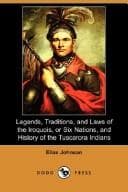
Legends, Traditions, and Laws of the Iroquois, or Six Nations, and History of the Tuscarora Indians — John Shaqi
Legends, Traditions, and Laws of the Iroquois, or Six Nations, and History of the Tuscarora IndiansJohnson, Elias
History
Legends, Traditions, and Laws of the Iroquois, or Six Nations, and History of the Tuscarora Indians
Johnson, Elias
Iroquois Indians; Tuscarora Indians
and mother, and perhaps of your brothers and sisters, so that you will be
alone. But endeavor in all things to please the Indians, and they will be
more kind to you. Do not forget your own language, and never fail to
repeat your catechism and the Lord's prayer every morning and evening
while you live." This she promised to do, and having kissed her child,
the mother was removed from her sight.
Mary must at this time have been ten years of age. She was afterwards
told, when she could understand the Indian language, that they would not
have killed her parents if the captors had not been pursued, and that a
little boy, who was the son of a neighbor, and was also taken, was given
to the French, two of whom were of the party.
In the marches of the Indians it was the custom for one to linger behind,
and poke up the grass with a stick after a party had passed along, to
conceal all traces of their footsteps, so a pursuit was seldom
successful. In deviating from a direct course in order not to get lost,
they noticed the moss upon the trees, which always grows thickest upon
the north side, as the south side being most exposed to the sun, became
soonest dry. They also had some knowledge of the stars, and knew from the
position of certain clusters that were to be seen at certain seasons,
which was east and which west.
Mary was adopted in place of two brothers who had fallen in battle, and
for whom the lamentations had not died away. The ceremony of adoption is
very solemn, requiring the deliberations of a council and the formal
bestowing of a name, as a sort of baptism, from which time the captive is
not allowed to speak any other language but the Indian, and must in all
things conform to Indian habits and tastes.
It is customary among them to give children a name which corresponds with
the sports and dependence of childhood, and when they arrive at maturity
to change it for one that corresponds with the duties and employments of
manhood and womanhood. The first name is given by the relatives and
afterwards publicly announced in council. The second is bestowed in the
same way; and by this they are ever afterward called, except on becoming
a Sachem, and, sometimes, on becoming a Chief or warrior another name is
taken, and each denotes definitely the new position. Each clan, too, had
its peculiar names, so that when a person's name was mentioned it was
immediately known to what clan he belonged.
Public-domain text, read in full here on John Shaqi.
Reviews
Reviews
No reviews yet
Be the first to share your thoughts on this work.
Join the Discussion
Join the discussion
Sign in to leave a comment or review.
Sign InorCreate an account