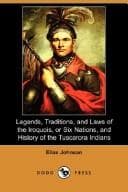
Legends, Traditions, and Laws of the Iroquois, or Six Nations, and History of the Tuscarora IndiansJohnson, Elias
History
Legends, Traditions, and Laws of the Iroquois, or Six Nations, and History of the Tuscarora Indians
Johnson, Elias
Iroquois Indians; Tuscarora Indians
A curious feature in the Indian code of etiquette is that it is
exceedingly impolite to ask a person's name, or to speak it in his
presence. In the social circle and all private conversation the person
spoken of is described if it is necessary to allude to him, as the person
who sits there, or who lives in that house, or wears such a dress. If I
ask a woman, whose husband is present if that is Mr. B-- she blushes, and
stammers, and replies, "He is my child's father," in order to avoid
speaking his name in his presence, which would offend him. On asking a
man his name he remained silent, not understanding the reason the
question was repeated, when he indignantly replied, "Do you think that I
am an owl to go about hooting my name everywhere?" The name of the owl in
Indian corresponding exactly to the note he utters.
When Mary Jemmison had been formally named De-he-wa-mis, they called her
daughter and sister, and treated her in all respects as if she had been
born among them and the same blood flowed in her veins, or rather, they
were accustomed to be more kind to captives than to their own children,
because they had not been inured to the same hardships. There was no
difference in the cares bestowed, no allusion was ever made to the child
as if it belonged to a hated race, and it never felt the want of
affection.
Mary said her tasks were always light, and everything was done to win her
love and make her happy. She now and then longed for the comforts of her
cottage home, and wept at the thought of her mother's cruel death, but
gradually learned to love the freedom of the forest, and to gambol freely
and gaily with her Indian play-mates. When she was named they threw her
dress away, and clothed her in deer skins and moccasins, and painted her
face in true Indian style. She never spoke English in their presence, as
they did not allow it, but when alone, did not forget her mother's
injunction, and repeated her prayers and all the words she could
remember, thus retaining enough of the language to enable her easily to
recall it when she should again return to civilized society, as she
constantly indulged the hope of doing, by an exchange of captives.
But when she was fourteen years of age, her mother selected for her a
husband, to whom she was married according to Indian custom. His name was
Sheningee, and though she was not acquainted with him previously, and of
course had no affection for him, but proved not only an amiable and
excellent man but a congenial companion, whom she loved devotedly. He had
all the noble qualities of an Indian, being handsome and brave, and
generous, and kind, and to her very gentle and affectionate.
Public-domain text, read in full here on John Shaqi.
Reviews
Reviews
No reviews yet
Be the first to share your thoughts on this work.
Join the Discussion
Join the discussion
Sign in to leave a comment or review.
Sign InorCreate an account