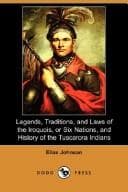
Legends, Traditions, and Laws of the Iroquois, or Six Nations, and History of the Tuscarora Indians — John Shaqi
Legends, Traditions, and Laws of the Iroquois, or Six Nations, and History of the Tuscarora IndiansJohnson, Elias
History
Legends, Traditions, and Laws of the Iroquois, or Six Nations, and History of the Tuscarora Indians
Johnson, Elias
Iroquois Indians; Tuscarora Indians
But only a little while was she permitted this happiness, her daughter
died while yet an infant, and when Sheningee was away. Again the feeling
of desolation came over her young spirit, but all around her ministered
in every way to her comfort, and became more than ever endeared to her
heart. After a long absence. Sheningee returned. She afterwards had a
son, and named him after her father, to which no objection was made by
her Indian friends, and her love for her husband became idolatry. In her
eyes he seemed everything noble and good: she mourned his departure and
longed for his return, for his affection prompted him to treat her with
gentle and winning kindness which is the spirit of true love alone.
But again the separation, and she must pass another winter alone. For
hunting was the Indian's toil, and though they delighted in it, the pangs
of parting from his wife and little one, made it a sacrifice, and spread
a dark cloud over a long period of his life. And now it became dark
indeed to Mary, for she waited long and Sheningee came not. She put
everything in order in his little dwelling. She dressed new skins for his
couch, and smoked venison to please his taste. She made the fire bright
to welcome him, hoping every evening when she lay down with her baby upon
her bosom, that ere the morning sun the husband and father would gladden
them by his smiles, but in vain; winter had passed away, and the spring,
and then came the sad tidings that he was dead, she became a widow and
her child fatherless.
Very long did she mourn Sheningee, for it seemed to her there was none
like him. But again the sympathies of his people created a new link to
bind her to them, and she said she could not have loved a mother or
sisters more dearly than she did those who stood in this relationship to
her, and soothed her with their loving words.
Not for four years was she again urged to marry, and during this time
there was an exchange of prisoners and she had an opportunity to return
to her kindred; she was left to do as she chose. They told her she might
go, but if she preferred to remain she should still be their daughter and
sister, and they would give her land for her own where she might always
dwell. Again she thought of the prejudice she would everywhere meet, and
that she could never patiently listen to reproaches concerning her
husband's people. It would not be believed that he was noble, because he
was an Indian; and she would have no near relatives and those she had
might reject her if she should seek them, so she came to the final
conclusion and never more sighed for the advantages or pleasures of
civilized life. She came with the brothers of Sheningee to the banks of
the Genesee, where she resided the remaining seventy-two years of her
life.
Public-domain text, read in full here on John Shaqi.
Reviews
Reviews
No reviews yet
Be the first to share your thoughts on this work.
Join the Discussion
Join the discussion
Sign in to leave a comment or review.
Sign InorCreate an account