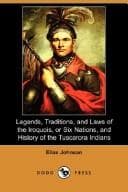
Legends, Traditions, and Laws of the Iroquois, or Six Nations, and History of the Tuscarora IndiansJohnson, Elias
History
Legends, Traditions, and Laws of the Iroquois, or Six Nations, and History of the Tuscarora Indians
Johnson, Elias
Iroquois Indians; Tuscarora Indians
Her second husband--Hiokatoo--she never learned to love. He was a Chief
and a warrior brave and fearless; but though he was always kind to her,
he was a man of blood. He delighted in deeds of cruelty and delighted to
relate them. And now the fire water had become common, and the good were
bad and the bad worse, so that dissensions arose in families and in
neighborhoods, and the happiness which had been almost without alloy was
no longer known among these simple people.
She adds her testimony to that of all travelers and historians concerning
the purity of their lives, having never herself received the slightest
insult from an Indian and scarcely knowing an instance of infidelity or
immorality. But when once they had tasted of the maddening draught the
thirst was insatiable, and all they had would be given for a glass of
something to destroy their reason. Now they were indeed converted into
fiends and furies and sold themselves to swift destruction.
Hiokatoo hesitated at no crime and took pleasure in everything dark and
terrible, but this was a small trial compared to those which Mrs.
Jemmison was called upon to endure from the intoxication and recklessness
of her son. Her eldest, the son of Sheningee, was murdered by John, the
son of Hiokatoo, who afterward murdered his own brother Jesse, and came
to the same violent death himself at the hands of others. When they came
to be in the midst of temptation there was no restraining principle, and,
even after they grew up her house was the scene of quarrels and confusion
in consequence of their intemperance, and she knew no rest from fear of
some calamity from the indulgence of their unbridled passions. The Chief
of the Seneca nation, to which her second husband belonged, gave her a
large tract of land, and when it became necessary that it should be
secured to her by treaty, she plead her own case. The commissioners
without inquiring particularly concerning the dimensions of her lots,
allowed her to make her own boundaries, and when the document was signed
and she was in firm possession it was found that she was the owner of
nearly four thousand acres, of which only a deed in her own hand-writing
could deprive her. But though she was rich she toiled not the less
dilligently and forsook not the sphere of woman in attending to the ways
of her household, and also, true to her Indian education, she planted and
hoed and harvested, retaining her Indian dress and habits till the day of
her death. During the revolutionary war her house was made the rendevous
and headquarters of British officers and Indian Chiefs, as her sympathies
were entirely with her red brethren, and the cause they espoused was the
one she preferred to aid. It was in her power to sympathize with many a
lone captive, she always remembered her own anguish at the prospect of
spending her life in the wilderness. The companion of Indians, and though
she had learned to love instead of fearing them, and knew they were, as a
Public-domain text, read in full here on John Shaqi.
Reviews
Reviews
No reviews yet
Be the first to share your thoughts on this work.
Join the Discussion
Join the discussion
Sign in to leave a comment or review.
Sign InorCreate an account