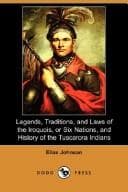
Legends, Traditions, and Laws of the Iroquois, or Six Nations, and History of the Tuscarora IndiansJohnson, Elias
History
Legends, Traditions, and Laws of the Iroquois, or Six Nations, and History of the Tuscarora Indians
Johnson, Elias
Iroquois Indians; Tuscarora Indians
The more you read, and the better you understand Indian history, the more
you will be impressed with the injustice which has been done the
Iroquois, not only in dispossessing them of their inheritance, but in the
estimation which has been made of their character. They have been
represented, as seen in the transition state, the most unfavorable
possible for judging correctly. In the chapter of National Traits of
Character, I have in two or three instances quoted Washington Irving and
might again allow his opinions to relieve my own from the charge of
partiality. He says, in speaking of this same subject, that "the current
opinion of Indian character is too apt to be formed from the miserable
hordes which infest the frontiers, and hang on the shirts of settlements.
These are too commonly composed of degenerate beings, corrupted and
enfeebled by the voice of society, without being benefited by its
civilization."
"The proud independence which formed the main pillar of motive virtue has
been spoken down, and the whole moral fabric lies in ruins. The spirits
are humiliated and debased by a sense of inferiority, and their native
courage cowed and daunted by the superior knowledge and power of their
enlightened neighbors. Society has advanced upon them like one of a those
withering airs that will sometimes breed desolation over a whole region
of fertility. It has enervated their strength, multiplied their diseases,
and superinduced upon their original barbarity the law-vices of
artificial life. It has given them a thousand superfluous wants, while it
has diminished their means of mere existence. It has driven before it the
animals of the chase, who fly from the sound of the axe and the smoke of
the settlement and seek refuge in the depths of remote forests, and yet
untrodden wilds. Thus do we often find the Indians in the frontiers to be
mere wrecks and remnants of once powerful tribes, who have lingered in
the vicinity of settlements, and sunk into precarious and vagabond
existence. Poverty, repining and hopeless poverty--a canker on the mind
before unknown to them--corrodes their spirits and blights every free and
noble qualities of their nature. They loiter like vagrants about the
settlements among spacious dwellings, replete with elaborate comforts,
which only renders them more sensible of the comparative wretchedness of
their own condition. Luxury spreads its ample board before their eyes,
but they are excluded from the banquet; plenty revels over the fields,
but they are starving in the midst of abundance. The whole wilderness
blossomed into a garden, but they feel as reptiles that infest them. How
different was their state while undisputed lords of the soil? Their wants
were few, and the means of gratification within their reach, they saw
every one among them sharing the same lot, enduring the same hardships,
feeding on the same aliments, arrayed in the same rude garment. No roof
Public-domain text, read in full here on John Shaqi.
Reviews
Reviews
No reviews yet
Be the first to share your thoughts on this work.
Join the Discussion
Join the discussion
Sign in to leave a comment or review.
Sign InorCreate an account