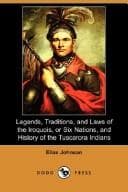
Legends, Traditions, and Laws of the Iroquois, or Six Nations, and History of the Tuscarora Indians — John Shaqi
Legends, Traditions, and Laws of the Iroquois, or Six Nations, and History of the Tuscarora IndiansJohnson, Elias
History
Legends, Traditions, and Laws of the Iroquois, or Six Nations, and History of the Tuscarora Indians
Johnson, Elias
Iroquois Indians; Tuscarora Indians
then rose under whose sheltering wings, that was not ever open to the
homeless stranger, no smoke curled among the trees, but he was welcome to
sit down by its fire and join the hunter in his repast."
In discussing Indian character, writers have been too prone to indulge in
vulgar prejudice and passionate exaggeration, instead of the candid
temper of the true philosopher. They have not sufficiently considered the
peculiar circumstance in which the Indians have been placed, and the
peculiar principles under which they having been educated. No being acts
more rigidly from rule than the Indians, his whole conduct is regulated
according to some general maxims early implanted in his mind. The moral
laws which govern him are few, but he conforms to them all. The white man
abounds in laws and religion, morals, and manners, but how many of them
does he violate. In their intercourse with the Indians the white people
were continually trampling upon their religion and their sacred rights.
They were expected to look merely on while the graves of their fathers
were robbed of their treasures, and the bones of their fathers were left
to bleach upon the fields. And when exasperated by the brutality of their
conquerors, and driven to deeds of vengence, there was very little
appreciation of the motives which influenced them, and no attempt was
made to palliate their cruelties.
It was their custom to bury the dead with their best clothing, and the
various implements they had been in the habit of using whilst living. If
it was a warrior that they were preparing for burial, they placed his
tomahawk by his side and his knife in his shield; with the hunter, his
bow and arrows and implements for cooking his food; with the woman, their
kettles and cooking apparatus and also food for all. Tobacco was
deposited in every grave; for to smoke was an Indian's idea of felicity
in the body and out of it, and in this there was not so much difference
as one might wish, between them and gentlemen of a paler hue.
Among the Iroquois, and many other Indian nations, it was the custom to
place the dead upon scaffolds, built for the purpose, from tree to tree,
or within a temporary inclosure, and underneath a fire was kept burning
for several days.
They had known instances of persons reviving after they were supposed to
be dead, and this led to the conclusion that the spirit sometimes
returned to animate the body after it had once fled. If there was no
signs of life for ten days, the fire was extinguished and the body left
unmolested until decomposition had begun to take place, when the remains
were buried, or, as was often the case, kept in the lodge for many years.
If they were obliged to desert the settlement where they had long
resided, these skeletons were collected from all the families and buried
in one common grave, with the same ceremonies as when a single individual
was interred.
Public-domain text, read in full here on John Shaqi.
Reviews
Reviews
No reviews yet
Be the first to share your thoughts on this work.
Join the Discussion
Join the discussion
Sign in to leave a comment or review.
Sign InorCreate an account