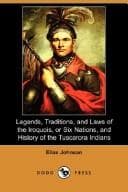
Legends, Traditions, and Laws of the Iroquois, or Six Nations, and History of the Tuscarora IndiansJohnson, Elias
History
Legends, Traditions, and Laws of the Iroquois, or Six Nations, and History of the Tuscarora Indians
Johnson, Elias
Iroquois Indians; Tuscarora Indians
The Indians lamentations, on being driven far away from the graves of
their fathers, have been the theme of all historians and travelers. It
can be easily imagined how those who so loved their homes and revered
their fathers' graves, would become fierce with indignation and rage, on
seeing themselves treated as without human feeling, and the sacred relics
of the dead ploughed up and scattered as indifferently as the stones, or
the bones of the moose and the deer of the forest. It was this feeling
that often prompted them to acts of hostility, which those who
experienced them, ascribed to wanton cruelty and barbarity.
In many of the villages there was a strangers home, a house, for
strangers where they were placed, while the old men went about collecting
skins for them to sleep upon, and food for them to eat, expecting no
reward.
They called it very rude for them to stare at them as they passed in the
streets, and said that they had as much curiosity as the white people,
but they did not gratify it by intruding upon them, by examining them.
They would sometimes hide behind trees in order to look at strangers, but
never stood openly and gaze at them.
Their respective attention to missionaries was often the result of their
rules of politeness, as it is a part of the Indian's code. Their councils
are eminent for decorum, and no person is interrupted during a speech.
Some Indians, after respectfully listening to a missionary, thought they
would relate to him some of their legends, but the good man could not
restrain his indignation, but pronounced them foolish fables, while what
he told them was sacred truth. The Indian was, in his turn, offended, and
said, we listened to your stories, why do you not listen to ours? you are
not instructed in the common rules of civility.
A hunter, in his wandering for game, fell among the back settlements of
Virginia, and on account of the inclemency of the weather, sought refuge
at the house of a planter, whom he met at the door. He was refused
admission. Being both hungry and thirsty, he asked for a bit of bread and
a cup of cold water. But the answer to every appeal was, "_You, shall
have nothing here, get you gone you Indian dog!_"
Public-domain text, read in full here on John Shaqi.
Reviews
Reviews
No reviews yet
Be the first to share your thoughts on this work.
Join the Discussion
Join the discussion
Sign in to leave a comment or review.
Sign InorCreate an account