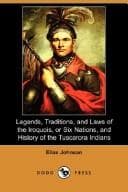
Legends, Traditions, and Laws of the Iroquois, or Six Nations, and History of the Tuscarora IndiansJohnson, Elias
History
Legends, Traditions, and Laws of the Iroquois, or Six Nations, and History of the Tuscarora Indians
Johnson, Elias
Iroquois Indians; Tuscarora Indians
Again, the same historian tells us that the few that remained, "stood
like sullen dogs to be killed rather than to implore mercy, and the
soldiers on entering the swamp, found many sitting together in groups,
when they approached, and resting their guns on the boughs of trees,
within a few yards of them, literally filled their bodies with bullets."
But they were Indians, and it was pronounnced a pious work. But when the
Gauls invaded Italy, and the Roman Senators, in their purple robes and
chairs of State, sat unmoved in the presence of barbarian conquerors,
disdaining to flee, and equally disdaining to supplicate for mercy, it
is applauded as noble, as dying like statesmen and philosophers. But the
Indians with far more to lose and infinitely greater provocation, sits
upon his mother earth upon the green mound, beneath the canopy of Heaven,
and refuses to ask mercy of civilized fiends, he is stigmatized as dogs,
spiritless, and sullen. What a different name has greatness, clothed in
the garb of christian princes and sitting beneath spacious domes, gorgeous
with men's device, and the greatness, in the simple garb of nature,
destitute and alone in the wilderness.
There is nothing in the character of Alexander of Macedon who "conquered
the world, and wept that he had no more to conquer," to compare with the
noble qualities of king Philip of Mt. Hope, and among his warriors are a
long list of brave men unrivalled in deeds of heroism, by any of ancient
or modern story. But in what country, and by whom were they hunted,
tortured, and slain, and who was it that met together to rejoice and give
thanks at every species of cruelty inflicted upon those who were fighting
for their wives, their children, their homes, their altars and their God.
When it is recorded that "men, women and children, indiscriminately, were
hewn down and lay in heaps upon the snow," it is spoken of as doing God's
service, because they were nominally heathen. "Before the fight was
finished, the wigwams were set on fire, and into those, hundreds of
innocent women and children had crowded themselves, and perished in the
general conflagration." And for those thanksgivings were sent up to
heaven, the head of Philip is strung upon a pole, and exposed to the
public. But this was not done by savage warriors, and the crowd that
huzzaed at the revolting spectacle, assembled on the Sabbath day, in a
Puritan church, to listen to the Gospel that proclaims peace and love to
all men. His body was literally cut in slices to be distributed among the
conquerors, and a christian city rings with acclamation.
Public-domain text, read in full here on John Shaqi.
Reviews
Reviews
No reviews yet
Be the first to share your thoughts on this work.
Join the Discussion
Join the discussion
Sign in to leave a comment or review.
Sign InorCreate an account