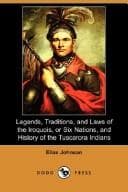
Legends, Traditions, and Laws of the Iroquois, or Six Nations, and History of the Tuscarora IndiansJohnson, Elias
History
Legends, Traditions, and Laws of the Iroquois, or Six Nations, and History of the Tuscarora Indians
Johnson, Elias
Iroquois Indians; Tuscarora Indians
In speaking of this bloody contest, one who is most eminent among the
fathers, says: "Nor could they cease praying unto the Lord against
Philip, until they had prayed the bullet through his heart." "Two and
twenty Indian captives were slain, and brought down to hell in one day."
"A bullet took him in the head, and sent his cursed soul in a moment
amongst the devils and blasphemers in hell forever."
Masasoit, the father of Philip, was the true friend to the English, and
when he was about to die, took his two sons, Alexander and Philip, and
fondly commended them to the kindness of the new settlers, praying them
the same peace and good will might be between them, that had existed
between him and his white friends. Upon mere suspicion only a short time
afterwards, the elder, who succeeded his father as ruler, among his
people, was hunted in his forest home, and dragged before the court, the
nature and object of which he could not understand. But the indignity
which was offered him, and the treachery of those who insulted him, so
chafed his proud spirit that a fever was the consequence, of which he
died. And that is not all. The son and wife of Philip were sold into
slavery, (as were also about eight hundred persons of the Tuscaroras, and
also many others of the Indians that were taken captive during the
Colonial wars.) "Yes," says a distinguished orator, (Everett,) "they were
sold into slavery, West Indian slavery. An Indian princess and her child,
sold from the cold breezes of Mount Hope, from a wild freedom of New
England forest, to drop under the lash, beneath the blazing sun of the
tropics."
Bitter as death, aye, bitter as hell! Is there anything--I do not think
in the range of humanity--is there any animal that would not struggle
against this? Nor is this indeed all. A kinswoman of theirs, a Princess
in her own right, Wetamore Pocasset, was pursued and harrassed till she
fell exhausted in the wilderness, and died of cold and starvation. There
she was found by men professing to be shocked at Indian barbarity, her
head severed from her body, and carried bleeding upon a pole to be
exposed in the public highways of the country, ruled by men who have been
honored as saints and martyrs.
"Let me die among my kindred," "Bury me with my fathers," is the prayer
of every Indian's heart; and the most delicate and reverential kindness
in the treatment of the bodies of the dead, was considered a religious
duty. There was nothing in all their customs that indicated a barbarism
so gross and revolting as these acts, which are recorded by New England
historians without a censure, while the Indian's protests in his grief at
seeing his kindred dishonored and his religion reviled, are stigmatized
as savage and fiendish.
Public-domain text, read in full here on John Shaqi.
Reviews
Reviews
No reviews yet
Be the first to share your thoughts on this work.
Join the Discussion
Join the discussion
Sign in to leave a comment or review.
Sign InorCreate an account