Jesus Christ -- Crucifixion -- Fiction; Palestine -- History -- To 70 A.D. -- Fiction; Polish fiction -- Translations into English
LET US FOLLOW HIM
[Illustration]
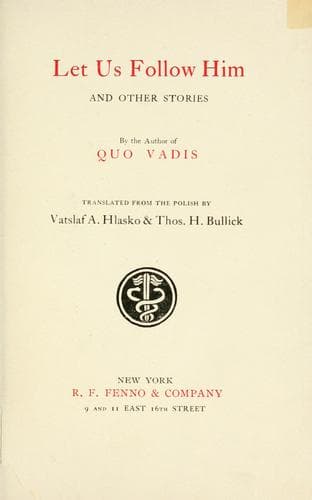
Let Us Follow Him
BY
HENRYK SIENKIEWICZ
AUTHOR OF
"Quo Vadis," "With Fire and Sword," Etc.
_Translated from the Polish_
BY JEREMIAH CURTIN
BOSTON
LITTLE, BROWN, AND COMPANY
1897
_Copyright, 1897_,
BY JEREMIAH CURTIN.
_All rights reserved._
Plimpton Press
H. M. PLIMPTON & CO., PRINTERS & BINDERS,
NORWOOD, MASS., U.S.A.
PUBLISHERS' NOTE.
Although the story "Let Us Follow Him" is included in the new volume by
Sienkiewicz entitled "Hania," just issued in uniform style with Mr.
Curtin's translations of the author's other works, its publication in a
separate volume has been deemed advisable for the reason that this story
gave to its author the idea of writing "Quo Vadis," which has been the
literary sensation of the past twelve months.
The period of "Let Us Follow Him" is that of the death of Christ. Antea,
the wife of a Roman patrician, ill with terrible visions, is advised by
a physician to seek the air of Jerusalem. There she and her husband
meet Pilate, who tells them of the doctrine of the Nazarene, Jesus, and
his condemnation to death. They are present at the Crucifixion, and
Antea gives honor to the condemned Nazarene, saying, "Thou art Truth."
LET US FOLLOW HIM.
CHAPTER I.
Caius Septimius Cinna was a Roman Patrician. He had spent his youth in
the legions and in severe camp-life. Later he returned to Rome to enjoy
glory, luxury, and a great though somewhat shattered fortune. He used
and abused at that time everything which the gigantic city could offer.
His nights were spent at feasts in lordly suburban villas; his days in
sword practice with fencers, in discussions with rhetors at the baths,
where disputes were held, and where the scandal of the city and the
world was related, in circuses, at races, at the struggles of
gladiators, or among Greek musicians, Thracian soothsayers, and
wonderful dancing-girls from the islands of the Archipelago. He
inherited from the renowned Lucullus, a relative on the mother's side, a
love for exquisite dishes. At his table were served Grecian wines,
Neapolitan oysters, Numidian mice, and locust fat preserved in honey
from Pontus.
Whatever Rome possessed Cinna must have, beginning with fish of the Red
Sea, and ending with white ptarmigans from the banks of the Borysthenes
(Dnieper). He made use of things not only as a soldier run riot, but as
a patrician who passes the measure. He had instilled into himself, or
had perhaps even roused in himself, a love for the beautiful,--a love
for statues rescued from the ruins of Corinth, for pitchers from Attica,
for Etruscan vases from foggy Sericum, for Roman mosaics, for fabrics
brought from the Euphrates, for Arabian perfumes, and for all the
peculiar trifles which filled the void of patrician life.
Public-domain text, read in full here on John Shaqi.
Reviews
Reviews
No reviews yet
Be the first to share your thoughts on this work.
Join the Discussion
Join the discussion
Sign in to leave a comment or review.
Sign InorCreate an account