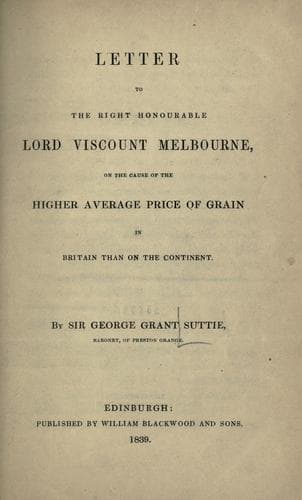
Letter to the Right Honourable Lord Viscount Melbourne on the Cause of the Higher Average Price of Grain in Britain than on the the ContinentGrant Suttie, George, Sir
History
Letter to the Right Honourable Lord Viscount Melbourne on the Cause of the Higher Average Price of Grain in Britain than on the the Continent
Grant Suttie, George, Sir
Corn laws (Great Britain); Great Britain -- Economic conditions; Melbourne, William Lamb, Viscount, 1779-1848
Produced by The Online Distributed Proofreading Team at
http://www.pgdp.net (This file was produced from images
generously made available by The Internet Archive/American
Libraries.)
LETTER
TO
THE RIGHT HONOURABLE
LORD VISCOUNT MELBOURNE,
ON THE CAUSE OF THE
HIGHER AVERAGE PRICE OF GRAIN
IN
BRITAIN THAN ON THE CONTINENT.
By SIR GEORGE GRANT SUTTIE,
BARONET, OF PRESTON GRANGE.
EDINBURGH:
PUBLISHED BY WILLIAM BLACKWOOD AND SONS.
1839.
EDINBURGH:
Printed by Andrew Shortrede, Thistle Lane.
LETTER.
The average price of grain in Britain has, for a long series of years,
been higher than in the neighbouring countries of Europe. It is of the
utmost importance to ascertain the cause or causes of this higher price.
The following appear to be the principal:--1st, Scarcity, the effect of
monopoly; 2d, The higher rate of taxation in this than in the
neighbouring nations; 3d, The higher rate of the real wages of labour in
this than in the other countries of Europe.
If it can be proved, that the first is the only cause of the higher
average price of grain in Britain, there can be no doubt that it is the
interest of every class in the community to have it removed: If the
second cause, the higher rate of taxation in Britain, has the slightest
influence on the price of grain, the question assumes a very different
aspect: And if the third cause, the higher real wages of labour in
Britain, has any connection whatever with the higher average price of
grain in Britain, the question of the Corn Laws would then evidently
connect itself with the best interests of the country. Those who
advocate the abolition of the Corn Laws, assume it to be proved, that
the higher average price of grain in Britain arises from scarcity, the
effect of monopoly: as, therefore, the cause of the higher price of
grain in Britain would be removed by the abolition of the Corn Laws,
they assert that the price here would be brought nearly to a level with
the price on the Continent, and that the evils which they consider
Britain labours under from a scarcity of food would be removed. Now, I
believe it will be admitted, that at no period of the history of Britain
has the average price of grain so far exceeded the price on the
Continent as during the present century; and I think it will also be
admitted, that at no period of the history of Britain, or of any other
nation, has so rapid an increase taken place in the amount of the
population, in the wealth, and, above all, in the amount of taxation
actually levied from the people. The state of the case is this: It is
asserted, that, for the last thirty-eight years, the inhabitants of
Britain have been labouring under the evil effects of a scarcity of
food, as proved by the higher average price of grain in Britain, when
compared with the price on the Continent. During the same period, the
population has increased in a greater degree than during any former
period; and the wealth of the country has increased to such an extent as
Public-domain text, read in full here on John Shaqi.
Reviews
Reviews
No reviews yet
Be the first to share your thoughts on this work.
Join the Discussion
Join the discussion
Sign in to leave a comment or review.
Sign InorCreate an account