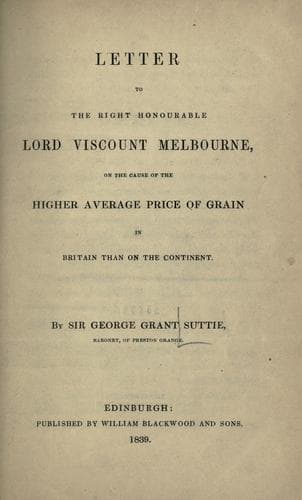
Letter to the Right Honourable Lord Viscount Melbourne on the Cause of the Higher Average Price of Grain in Britain than on the the ContinentGrant Suttie, George, Sir
History
Letter to the Right Honourable Lord Viscount Melbourne on the Cause of the Higher Average Price of Grain in Britain than on the the Continent
Grant Suttie, George, Sir
Corn laws (Great Britain); Great Britain -- Economic conditions; Melbourne, William Lamb, Viscount, 1779-1848
to excite the wonder and envy of the world; and the substantial nature
of this wealth is proved by the amount of the revenue raised from it by
taxation, greatly exceeding the revenue of any other country. This view
of the question must, I think, dispose any dispassionate person to
doubt, that an absolute scarcity of food for the last thirty-eight years
in Britain has been the sole cause of the higher average price of grain
during that period. In order to prove that a certain effect is produced
by a given cause, it is desirable to shew, that the same effect could
not be produced by any other cause; and this naturally leads me to
consider how far the higher average price of grain in Britain may arise
from the other two causes. I think it is admitted, even by those who
advocate the abolition of the Corn Laws, that the price of grain is
influenced by taxation in the same way, but only to the same extent, as
the price of manufactures. They admit that the wages of the labourers
must be increased in proportion to the increase by taxation on the price
of commodities consumed by them; and the great leading cause of
complaint at the present moment on the part of the abolitionists and
manufacturers, is, that in all articles requiring much manual labour,
Britain is at present, and must continue to be, undersold in future by
the cheaper labour of the Continent. Now, it will not be denied, that
manual labour enters to an infinitely greater extent into the production
of food than into the production of any other manufacture. If, therefore
the manufacturers complain, with justice, that the higher rate of
taxation, by raising wages, prevents them from competing with
continental manufacturers, the same argument applies to the
agriculturist, only with infinitely greater force, in proportion to the
trifling assistance which machinery has as yet afforded to manual labour
in the production of food. The whole population of Britain would not be
able to do for the manufacturers in a year what the steam engine does
for them in a day; but coal, the food, or moving power of the steam
engine is absolutely cheaper in Britain than in any country in the
world. If it is admitted that the higher rate of taxation has any
influence whatever in raising or maintaining the price of grain in this
country, it must also be admitted, that some degree of protection is
just and necessary. With respect to the higher real wages of labour, if
there should appear the slightest ground for thinking that a higher rate
of real wages has any tendency to raise or maintain the average price of
grain in Britain above the average price of the Continent, any attempt
to reduce that price by enabling foreign grain to supplant that of
British growth in the home market, must be deprecated as an experiment
of the most dangerous nature for the labouring classes of the community.
I am aware that I am not entitled to assume, that the real wages of
Britain are higher than the real wages of the Continent.
Public-domain text, read in full here on John Shaqi.
Reviews
Reviews
No reviews yet
Be the first to share your thoughts on this work.
Join the Discussion
Join the discussion
Sign in to leave a comment or review.
Sign InorCreate an account