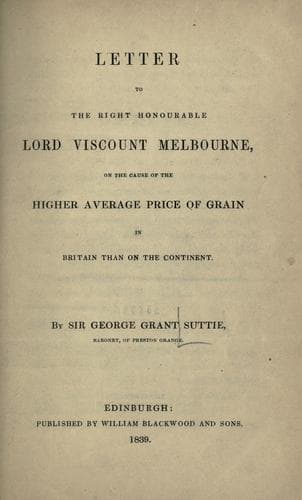
Letter to the Right Honourable Lord Viscount Melbourne on the Cause of the Higher Average Price of Grain in Britain than on the the ContinentGrant Suttie, George, Sir
History
Letter to the Right Honourable Lord Viscount Melbourne on the Cause of the Higher Average Price of Grain in Britain than on the the Continent
Grant Suttie, George, Sir
Corn laws (Great Britain); Great Britain -- Economic conditions; Melbourne, William Lamb, Viscount, 1779-1848
Those who
advocate abolition of the Corn Laws, point unceasingly to the difference
in price between the principal continental markets, such as Hamburgh,
Danzig, Berlin, and this country. I might, in the same way, point to the
wages in Britain as being at least four times the wages of these
countries; but neither would be a fair mode of arriving at the true
state of the case. Divide the quarter of wheat, at the average price of
each country, by the wages of each country, that will give the real
wages of each. Fortunately, Mr Jacob's report on the Corn Trade affords
the most satisfactory means for instituting a comparison both as to the
price of grain and the rate of real wages _in Britain and in those
countries_. From his report it appears that the average price of the
quarter of wheat for five years, ending with 1824, was 27s. in Prussia.
The average price of Britain was, for the same period, 55s. The wages of
Prussia are stated to be 2s. 6d. per week, and of Britain, 10s. per
week. The real wages, therefore, the quantity of wheat the labourers
could purchase, was double in Britain what it was in Prussia. In a
national point of view, labour is the true standard of value; if it is
admitted that labour in Britain exchanges for a greater quantity of
grain than it does in Prussia, it follows that grain is cheaper in
Britain.
I shall now advert to what may almost be termed a fourth cause for the
higher average price of grain in Britain--the cultivation of poor land.
This the abolitionists maintain to be the necessary and natural
consequence of monopoly. It would be an arduous task to enumerate all
the pamphlets that have been written to prove the immense extent of poor
lands at present cultivated in Britain, that must be thrown out of
cultivation, in order to supply the labouring population with cheaper
bread. It must be borne in mind that Britain, for the last thirty-eight
years, has been on a starving system, as proved by the higher average
price of grain during that period. The abolitionists being, however, a
little startled at the fact, that a people in a state of starvation, as
compared with Prussia or Poland, should have increased in population, in
wealth, and in the ability to bear taxation, call to their aid the
theory of the cultivation of poor lands. They say the people have not
been absolutely starved, but their food has been raised on poor land by
an immense and unnecessary expenditure of labour, and their infallible
remedy is to throw these poor lands, amounting to a half, a third, or a
fourth of the soils of Britain, according to the theory of the different
writers, out of cultivation. Import, they say, the cheap grain, the
produce of the fertile soils of Prussia and Poland, which being cheaper
must be the produce of much less labour. Though volumes have been
written to prove the evil effects of cultivating the poor soils of
Britain, no one has yet, that I am aware of, devoted a single sentence
to prove the fact.
Public-domain text, read in full here on John Shaqi.
Reviews
Reviews
No reviews yet
Be the first to share your thoughts on this work.
Join the Discussion
Join the discussion
Sign in to leave a comment or review.
Sign InorCreate an account