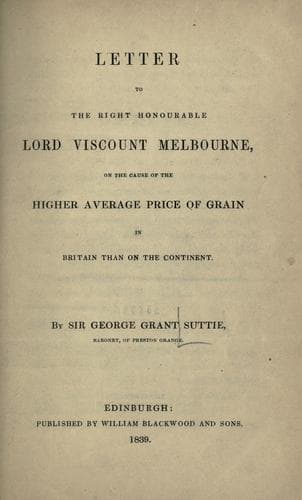
Letter to the Right Honourable Lord Viscount Melbourne on the Cause of the Higher Average Price of Grain in Britain than on the the ContinentGrant Suttie, George, Sir
History
Letter to the Right Honourable Lord Viscount Melbourne on the Cause of the Higher Average Price of Grain in Britain than on the the Continent
Grant Suttie, George, Sir
Corn laws (Great Britain); Great Britain -- Economic conditions; Melbourne, William Lamb, Viscount, 1779-1848
the value of its produce is reduced from the effects of importation. But
even if we admit that a great reduction in the value of the agricultural
produce in Britain would not make it more difficult to collect the
immense revenue required by this country, still the debt is considered
to press with sufficient weight on the energies of the country as it is.
As a permanent reduction in the value of the agricultural produce of
Britain would give the national creditor the power to purchase a much
larger quantity of it than he now enjoys, to that extent it would
increase the pressure of the debt, by adding most materially to its real
value. In short, the British labourer consumes, or has the power of
consuming, at least double the quantity of wheat that a Prussian or
Polish labourer has. The soil of Britain, in proportion to its
cultivated surface, produces double the quantity of grain, and maintains
four times the number of cattle that is maintained by the land in
Prussia or Poland. Taxation is admitted by all to raise the money price
of grain; and, according to Colonel Torrance, taxation will even produce
artificial sterility in land. The amount of the population engaged in
British agriculture is less in proportion to the amount engaged in
trade and manufactures than in any country in the world, yet this small
proportion of the people of Britain raises a larger supply of food for
the whole population than is enjoyed by any nation of similar magnitude:
the whole population consume, or has the power of consuming, double the
quantity of food that the Poles or Prussians have.
From these facts it is evident that the food of Britain is produced by
much less labour than the food of Poland or Prussia. Indeed, if this was
not the case, how could the immense population engaged in manufactures,
and concentrated in the large cities of the empire, be supported? I
hold, therefore, that I am justified in asserting that the higher rate
of taxation in Britain, and the higher rate of real wages, have a very
powerful influence in maintaining the higher average price of grain in
Britain as estimated in money; that the theory of the cultivation of
poorer land in Britain than in the countries from which it is proposed
we should obtain our supplies of grain, is utterly without foundation in
fact; and that, on the contrary, the agricultural produce of Britain is
the result of less labour than in the neighbouring countries of Europe;
that labour in Britain produces more grain, and also exchanges for more.
It therefore follows, that the mode of introducing foreign corn into
this country ought to be regulated so as not to interfere with the
extension of cultivation in Britain, or to prevent the produce from
increasing, as it has hitherto done, in proportion to the increase of
the population.
EDINBURGH:
Printed by ANDREW SHORTREDE, Thistle Lane.
Public-domain text, read in full here on John Shaqi.
Reviews
Reviews
No reviews yet
Be the first to share your thoughts on this work.
Join the Discussion
Join the discussion
Sign in to leave a comment or review.
Sign InorCreate an account