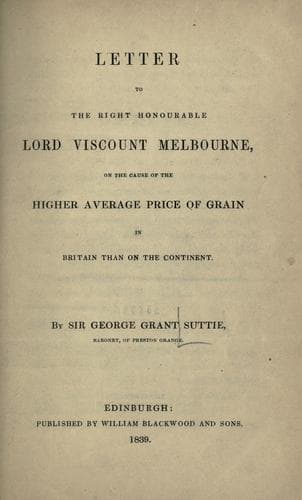
Letter to the Right Honourable Lord Viscount Melbourne on the Cause of the Higher Average Price of Grain in Britain than on the the ContinentGrant Suttie, George, Sir
History
Letter to the Right Honourable Lord Viscount Melbourne on the Cause of the Higher Average Price of Grain in Britain than on the the Continent
Grant Suttie, George, Sir
Corn laws (Great Britain); Great Britain -- Economic conditions; Melbourne, William Lamb, Viscount, 1779-1848
It is much easier to take the fact for granted, and
then proceed to argue on it. The only argument I have ever heard adduced
in favour of the theory, that poorer lands are cultivated in Britain
than in Prussia or elsewhere, is, that the average price of grain is
higher; but I never can admit the force of an argument deduced from such
premises as these, that corn is high because poor land is cultivated,
and that poor land is cultivated because corn is high.
I shall now proceed to state a few facts taken from Mr Jacob's report,
which prove the very reverse to be the truth. I may begin by observing,
that to any one who has travelled over the north of Germany or Poland,
any argument to prove that poorer land is cultivated in these countries
than in Britain is superfluous--the general aspect of these countries
being that of a sandy desert. Mr Jacob states, that the land in Prussia
is cultivated by a class of persons in some respects slaves, and, in
most respects, but little removed from that state; and that there is no
class in this country with whom their condition can be compared. He
states, that the average return of wheat, oats, barley, and rye, is four
for one--in Britain the same average is, at least, eight for one. He
states, that the stock of sheep and cattle, in proportion to the
surface, will be at least four times greater in Britain than in Prussia.
In a country such as Britain, maintaining four times the number of
cattle, and giving double the return of grain per acre, it is rather too
much to assume, without even an attempt at inquiry, that an immense
extent of poor and unprofitable land is cultivated. The cultivation of
poorer land in Britain than in other countries, being the key-stone of
the arch on which such a mass of argument rests, it seems most strange
that no attempt should ever have been made to establish the fact. The
higher price of grain may so clearly be produced by other causes besides
monopoly, and the consequent cultivation of poorer land, that the
abolitionists were bound to prove monopoly to be the sole agent. So far
from doing this, many of their own champions admit the force of other
causes, as being most efficient in maintaining the higher averages of
grain in Britain. Colonel Torrance, who, I believe, is considered a high
authority with the abolitionists, states, that if, by taxing our land,
we increase the expense of growing corn at home beyond the expense of
producing it in other countries, our prices will be higher than theirs.
In this opinion I fully agree with Colonel Torrance, though I do as
decidedly differ in an opinion he states immediately preceding that
above quoted, where he asserts that the happiest consequences follow
from leaving importation free. When what he terms artificial sterility
is produced by the pressure of taxation on the land, the Colonel does
not explain, in his elaborate work, how, if the cause of higher price is
taxation, the same amount of taxation is to be paid by the land, when
Public-domain text, read in full here on John Shaqi.
Reviews
Reviews
No reviews yet
Be the first to share your thoughts on this work.
Join the Discussion
Join the discussion
Sign in to leave a comment or review.
Sign InorCreate an account