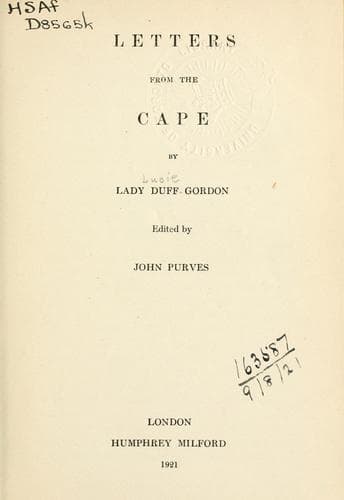
Cape of Good Hope (South Africa) -- Description and travel
Luckily, on Saturday the wind dropped, and we started at nine o’clock,
drove to a place about four miles from Capetown, when we turned off on
the ‘country road’, and outspanned at a post-house kept by a nice old
German with a Dutch wife. Once well out of Capetown, people are civil,
but inquisitive; I was strictly cross-questioned, and proved so
satisfactory, that the old man wished to give me some English porter
gratis. We then jogged along again at a very good pace to another
wayside public, where we outspanned again and ate, and were again
questioned, and again made much of. By six o’clock we got to the Eerste
River, having gone forty miles or so in the day. It was a beautiful day,
and very pleasant travelling. We had three good little half-Arab bays,
and one brute of a grey as off-wheeler, who fell down continually; but a
Malay driver works miracles, and no harm came of it. The cart is small,
with a permanent tilt at top, and moveable curtains of waterproof all
round; harness of raw leather, very prettily put together by Malay
workmen. We sat behind, and our brown coachman, with his mushroom hat,
in front, with my bath and box, and a miniature of himself about seven
years old—a nephew,—so small and handy that he would be worth his weight
in jewels as a tiger. At Eerste River we slept in a pretty old Dutch
house, kept by an English woman, and called the Fox and Hound, ‘to sound
like home, my lady.’ Very nice and comfortable it was.
I started next day at ten; and never shall I forget that day’s journey.
The beauty of the country exceeds all description. Ranges of mountains
beyond belief fantastic in shape, and between them a rolling country,
desolate and wild, and covered with gorgeous flowers among the ‘scrub’.
First we came to Hottentot’s Holland (now called Somerset West), the
loveliest little old Dutch village, with trees and little canals of
bright clear mountain water, and groves of orange and pomegranate, and
white houses, with incredible gable ends. We tried to stop here; but
forage was ninepence a bundle, and the true Malay would rather die than
pay more than he can help. So we pushed on to the foot of the mountains,
and bought forage (forage is oats _au natural_, straw and all, the only
feed known here, where there is no grass or hay) at a farm kept by
English people, who all talked Dutch together; only one girl of the
family could speak English. They were very civil, asked us in, and gave
us unripe apricots, and the girl came down with seven flounces, to talk
with us. Forage was still ninepence—half a dollar a bundle—and
Choslullah Jaamee groaned over it, and said the horses must have less
forage and ‘more plenty roll’ (a roll in the dust is often the only
refreshment offered to the beasts, and seems to do great good).
Public-domain text, read in full here on John Shaqi.
Reviews
Reviews
No reviews yet
Be the first to share your thoughts on this work.
Join the Discussion
Join the discussion
Sign in to leave a comment or review.
Sign InorCreate an account